
17,000 foreign-owned companies do 46% of Portugal's exporting
An Informa D&B study counts 17,000 foreign-capital firms in Portugal. They employ 808,000 people, turn over 173 billion euros and account for 52 billion in exports.
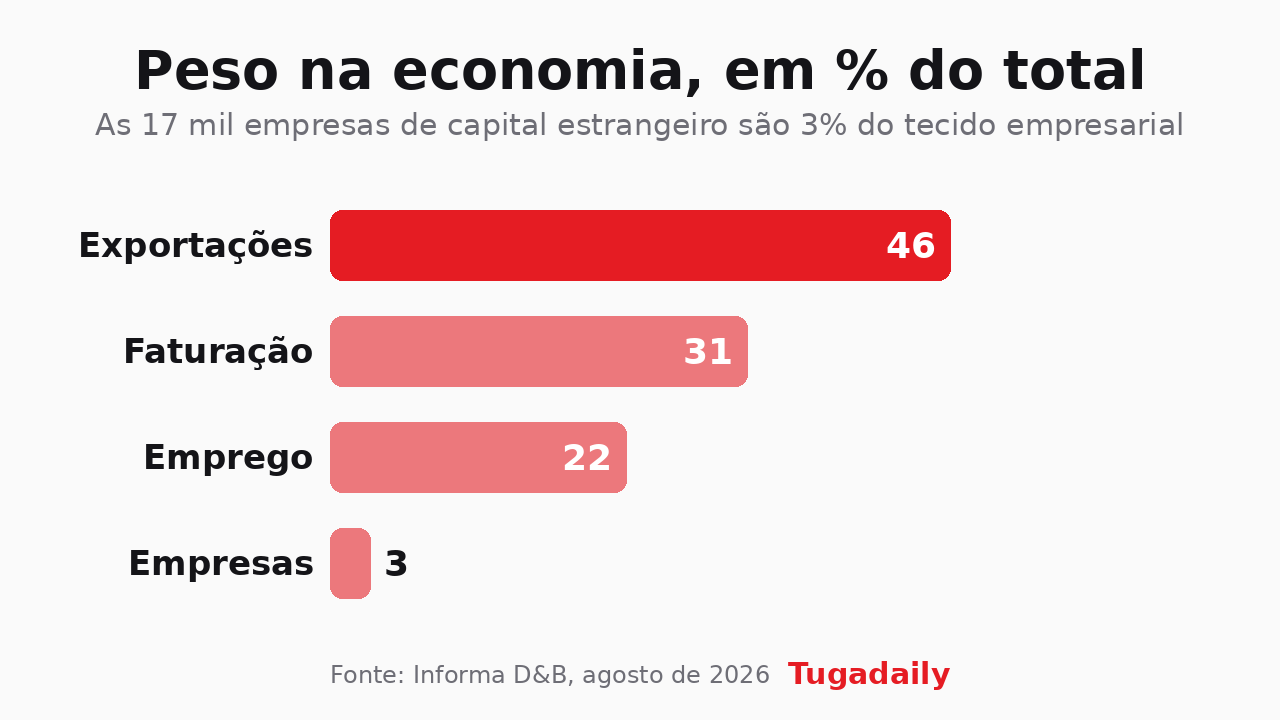
There are 17,000 foreign-capital companies registered in Portugal. They are 3% of the country’s business base and, according to the Informa D&B study released on Thursday, they are behind 46% of everything Portugal exports.
The rest of the picture comes from the same source. These firms account for 31% of the combined turnover of all Portuguese companies, 22% of employment and 15% of the gross value added generated by business. In absolute terms: 808,000 workers, 173 billion euros of turnover, 52 billion in exports and 44 billion in GVA. Of the 17,000, some 9,721 were set up in the last decade, meaning more than half the group is under ten years old.
A gap that size alone does not explain
The obvious explanation is scale. Bigger companies export more. But the study finds a behavioural difference that scale does not fully account for. Among foreign-capital firms, 28% export. Among Portuguese-owned firms, 8% do. That is a ratio of roughly three and a half to one.
The same pattern shows up in productivity. Informa D&B places 40% of foreign-capital companies in its high or medium-high productivity bands, against 31% of domestic ones.
Spain has the most doors open
Spain leads on shareholder origin, with 3,684 companies in Portugal, or 21% of the total. Between them, Spain and France concentrate 8.1% of employment and 11.2% of turnover across the whole foreign-capital universe.
The best payer is somewhere else, though. Foreign-capital firms spend an average of 33,000 euros per employee on staff costs, ten thousand more than domestically owned ones. For US-owned companies, that average climbs to 50,000.
Why the number matters beyond the number
An economy where 3% of companies place almost half the exports carries a very particular concentration of risk: decisions taken outside the country move a large slice of the trade balance. It is the flip side of a dependence readers here already know from another sector, when we set out how much of Portugal’s growth came from tourism, and it sits awkwardly next to the pay figures INE published for the second quarter. Informa D&B publishes its studies of the Portuguese business base on its own site.
By Beatriz Mota
Chart: Tugadaily · data from the Informa D&B study, August 2026