

Markets tracker: gold, the Fed, oil and stocks
Our running tracker of the markets that move savings in Portugal — gold, Fed and ECB decisions, oil and stocks. Updated whenever there is news.
This is our running tracker of the markets that move savings in Portugal. Instead of a fresh article for every swing, we update this page whenever something matters: gold, Federal Reserve and European Central Bank decisions, oil and the main stock indices. For the background on the Portuguese economy, see our mid-year review. Official data is at the Bank of Portugal.
Updates
21 August 2026
Lisbon led Europe’s gains through Friday morning, with retail out in front: Jerónimo Martins was up 1.77% and Sonae 1.26%, followed by EDP Renováveis at 1.25% and BCP at 1.10%. The whole PSI was trading higher, though Galp barely moved at 0.05%. The other side of the ledger is debt. Renewed tension in European bond markets has pushed up the yields demanded of Portugal, and the higher cost of financing now weighs on the preparation of the 2027 state budget, even with the country’s fundamentals still acting as a shock absorber.
2 August 2026
Gold closed a zigzagging week: it opened near $4,051 an ounce, briefly lost the $4,000 handle on Wednesday and touched $3,995.90 before clawing back. The turning point was the Federal Reserve, which held rates at 3.50-3.75% and sent gold up 2% on the day as the dollar and Treasury yields eased. But three votes favoured a hike, which cooled anyone betting on cuts. With oil feeding inflation worries again, the underlying direction is still unresolved.
1 August 2026
Oil closed out July with a push: Brent rose about 1.4% to around $90.25 a barrel and US crude gained close to 2.2% on Friday, dragging Treasury yields up with it in a market fretting about inflation again. On equities, Apple spoiled the big-tech party: it posted $109.4bn in revenue, up 16% year on year, then took the shine off with guidance of 9% to 11% growth for the current quarter and a warning about shortages of advanced chip components. For anyone holding a Portuguese mortgage the read-across is the familiar one: expensive oil feeds inflation, and inflation feeds the rate conversation.
30 July 2026
The Federal Reserve left rates where they were, in the 3.50% to 3.75% range, for a fifth consecutive meeting. The vote was not unanimous: three of the twelve voters wanted a 0.25 point increase, with inflation proving stubborn and political pressure adding to the noise. The next meeting is on 15 and 16 September, and that is where the market is now placing its bets on a hike. For anyone with a mortgage in Portugal the read is indirect but real: a stronger dollar and stalled US rates leave Euribor little room to fall in the short term.
29 July 2026
Oil turned around again. Brent climbed more than 4% to near 88 dollars a barrel after the US said it had intercepted Iranian ballistic missiles fired at its forces in the Middle East, snapping three straight sessions of losses that had added up to roughly 16% — the steepest such fall since 2020. Gold went the other way, slipping about 1% to 4,030 dollars an ounce under a stronger dollar. All of it ahead of the Federal Reserve decision: markets put roughly a one-in-three chance on a rate rise at this meeting and close to 80% on one in September, which is a lot of uncertainty this close to the announcement.
28 July 2026
The European Central Bank left its key rates untouched at the July meeting, after June’s hike, saying it wants more data before moving again. For anyone paying a mortgage in Portugal that is a breather: 12-month Euribor traded at 2.993% on Monday, the six-month rate at 2.723% and the three-month at 2.488%. Anyone facing a reset in the coming weeks should land close to what they already pay, rather than another step up.
26 July 2026
Oil went into the weekend pinned near 100 dollars a barrel, with the blame split between two fronts. The US paused its strikes on Iran for the first time in almost two weeks, which in another context would have eased the risk premium, but Houthi rebels hit two Saudi tankers in the Red Sea and handed the nerves straight back. Meanwhile new US tariffs of 10% to 12.5% took effect on imports from 60 trading partners, including China, Türkiye, Brazil and Russia.
24 July 2026
The PSI slipped 0.27% in the latest session to 9,252.58 points, still near highs Lisbon’s market hasn’t seen in almost two decades. Galp was the standout gainer, up 3.71% to 20.96 euros, while postal operator CTT led the fallers, down 4.67%. Abroad, the ECB left rates where they were, and markets are increasingly convinced the next move is a September hike as inflation shows fresh signs of life.
22 July 2026
Oil jumped to a six-week high, with Brent up around 2.7% to near 93 dollars a barrel, pushed by the military escalation between the US and Iran. On Wall Street, stocks slipped as investors waited on quarterly results from Alphabet and Tesla, released after the close, with the tech-heavy Nasdaq down 0.5%.
Portugal’s PSI is still holding above 9,000 points, hovering around 9,100 — a level Lisbon’s exchange hadn’t seen in almost two decades. In recent sessions BCP has led the gains, rising more than 1%. Abroad, gold is shining again as a safe haven, trading near $4,070 an ounce, up more than 1.5%.
21 July 2026
Wall Street closed Monday in the red and Europe followed, with a tech sell-off and Brent climbing on Gulf tensions. The exception was Alphabet, up around 3% on news that Google is preparing a more efficient chip for Gemini. The week ahead belongs to Big Tech earnings — with Google’s parent opening the show.
20 July 2026
A red Monday on the markets: tech stocks led a sell-off that painted Europe red, with Asia setting the tone — TSMC fell 7 percent and Japan’s Kioxia tumbled 16, squeezed by the buzz around cheaper Chinese AI models. In London, Burberry sank more than 6 percent. Meanwhile Brent rose as the Middle East conflict escalated after the US struck the Darkhovin nuclear plant — pricier energy and falling tech, the cocktail investors least like to drink.
18 July 2026
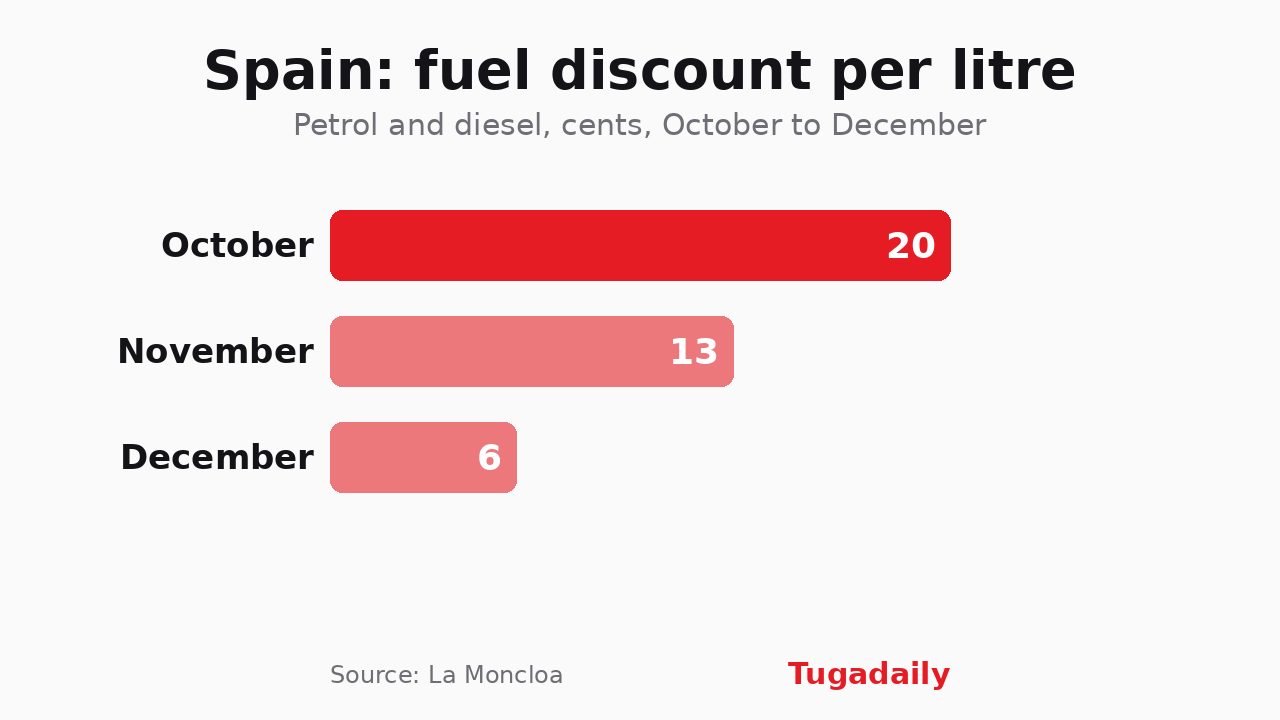
A heavy week at the pumps: per ACP and DGEG figures, diesel rises about 13.5 cents per litre from Monday (to around 1.988 euros) and petrol 6.5 cents (1.980) — reflecting oil jumping over 4% on Friday amid the Gulf escalation. Note: the rise we estimated here yesterday (1.35 cents) was off by a decimal place; now corrected. As the increase tops 10 cents, the government has pledged to trigger the extraordinary ISP cut.
17 July 2026
European stocks closed the week lower, dragged by another tech-sector sell-off — chipmakers especially — as China’s open-weight Kimi K3 launch reignited the debate over AI valuations (in Hong Kong, Z.ai fell as much as 30% and MiniMax 16%). Lisbon was the exception: the PSI added 0.27% to 9,062 points, with Teixeira Duarte up 3.19% and Jerónimo Martins 2.12%, while BCP slipped 1.11%. At the pumps, next week brings sharp increases: around 13.5 cents on diesel and 6.5 on petrol, per ACP and DGEG figures.
16 July 2026
June US inflation came in softer than feared (3.5% year on year) and changed the conversation: the odds of a Fed hike on 28-29 July fell from 35% to 10%. Stocks closed slightly higher in relief. Oil still lives and dies by Hormuz — Brent eased to 84.65 dollars (+1.75%) after touching 87 — and gold slipped 0.6% to 4,028 dollars an ounce.
11 July 2026
Gold slipped 0.6% on Friday to $4,115 an ounce, while oil edged higher on Strait of Hormuz tensions — WTI closed near $72 and Brent at $76. On Wall Street the week ended positive despite a mixed Friday, marked by South Korea’s SK Hynix debuting on the Nasdaq, the largest-ever US listing by a foreign company.
10 July 2026
The week brought two market debuts shaking up the chip sector: South Korea’s SK Hynix, the AI-memory giant, debuted on US markets, while AirPods-maker Luxshare had a tepid start in Hong Kong, closing below its listing price. A sign of the times: appetite for AI-linked semiconductors persists, but it is no longer a blank cheque.
8 July 2026
Oil surged more than 6% after Donald Trump declared the ceasefire with Iran over, following attacks on three tankers near the Strait of Hormuz: WTI neared 75 dollars and Brent 79, the biggest daily jump since early June. US stocks fell, with Dow futures losing more than 500 points, and the US Treasury revoked the waiver allowing Iranian oil onto the global market. Fuel prices in Portugal should reflect the rise as early as next week.
8 July 2026
The PSI traded near 9,217 points (+0.35% at the last close), gold held high around 4,143 dollars an ounce, and the euro was worth about 1.14 dollars. Steady European stocks and still-expensive bullion.
7 July 2026
Gold steadied near 4,150 dollars an ounce as investors awaited the minutes of the Fed’s June meeting, now pricing roughly a 50% chance of a September rate hike after US job growth cooled. On Wall Street the Dow holds above 53,000 points, while oil eased as traffic through the Strait of Hormuz kept recovering and OPEC+ agreed to lift production quotas for next month.
6 July 2026
OPEC+ confirmed another production increase and oil opened the week lower. Gold slipped from around 4,200 to near 4,143 dollars an ounce in a technical pullback, and Asian markets closed mostly in the red. On Wall Street, futures returned from the July 4th holiday with no clear direction as investors reassess the payoff of AI spending.
5 July 2026
Gold shone again at the start of July: it climbed close to $4,122 an ounce on 2 July, a jump of about 2.25% in a single day. Central banks, led by China, keep buying to diversify reserves and cut their dollar dependence, and the World Gold Council sees room for further gains by year-end. For savers, the metal remains a safe haven in a half-year marked by geopolitical tension.
4 July 2026
Wall Street closed the first half at record highs and pulled European savings along with it. Gold trades near a multi-week low as the market adjusts its bets on the Fed’s next move.
2 July 2026
Gold slipped to a recent low on expectations of higher rates for longer. Oil steady after the easing in the Strait of Hormuz.
30 June 2026
Month-end: gold posted a fourth straight monthly fall; European stocks swung on earnings and central-bank cues.
By Beatriz Mota
Image: Stevebidmead / Wikimedia Commons (CC0)