
PT
The cloister of the Colégio do Espírito Santo at the University of Évora, with white arcades around a central fountain
Immigration 12 September 2026

Where do Évora's 650 international students file their residence papers now? On campus

The University of Évora and AIMA have opened a CLAIM office in the Santo Agostinho building, staffed by two people trained to file cases directly in the agency's system. Biometrics are still collected in Lisbon.

Studying in Évora on a non-EU passport used to mean solving the first step of your residence process 130 kilometres away. Not any more. On Wednesday the University of Évora and AIMA opened a CLAIM office — the local migrant integration support centre — in the Santo Agostinho building, and it began operating the same day.

Two university staff run it, trained by AIMA to work directly inside the agency’s case system. This is not an information desk. Cases are now filed on campus.

What it does, and what it does not

Once a case is filed there, it moves to AIMA’s central services, which issue the decision. Biometric data is still collected afterwards at the agency’s premises in Lisbon. So the trip has not disappeared — it has simply stopped being the first thing that has to happen, and the first step is where these processes usually stall.

Rector António Candeias put numbers to the need. The university has around 650 international students, roughly 600 of them from outside the European Union, and its foreign academic community, counting lecturers, researchers and staff, comes from more than 80 countries. The protocol with AIMA was signed back in October 2025, under the previous rectory.

A wider network than you would guess

Pedro Portugal Gaspar, who chairs AIMA’s board, says there are about 100 municipal CLAIM offices and close to 50 run by associations and civil society bodies. In higher education the network is approaching ten. They do not all do the same job: some handle document processing, as this one does, while others focus on information and social integration.

There is a second aim behind the first. The university wants to make it easier to bring in foreign lecturers and researchers for short stays — a master’s module, a single course unit — without paperwork making the decision for them.

In a later phase, the institution wants to test the office’s capacity and extend the service to the wider migrant population of Évora and the region, working with the city council and the Santa Casa da Misericórdia.

If you have a case in progress, read this alongside our running AIMA tracker and, if you are a student, the new student visa rules that took effect this month. Institutional detail for students coming from abroad is on the University of Évora’s international students page.

By Juliana Castilho

Image: Vitor Oliveira / Wikimedia Commons (CC BY-SA 2.0)

A Loja do Cidadão citizen shop, home to AIMA service desks
Immigration 18 September 2026

AIMA tracker: deadlines, backlog and updates

A running tracker of AIMA — case backlog, renewal deadlines, biometrics, golden visa and service changes. Updated whenever there is news.

If you are dealing with residence or nationality, this is the page to bookmark. Instead of one article per announcement, we gather the essentials of AIMA here: case backlog, renewal deadlines, biometrics, golden visa and service changes. For the citizenship rules, see the new nationality law. Official information is at AIMA. A small, practical change to the Renewals Portal: EU citizens and their family members no longer have to supply a NIF or a NISS when…

Continue reading
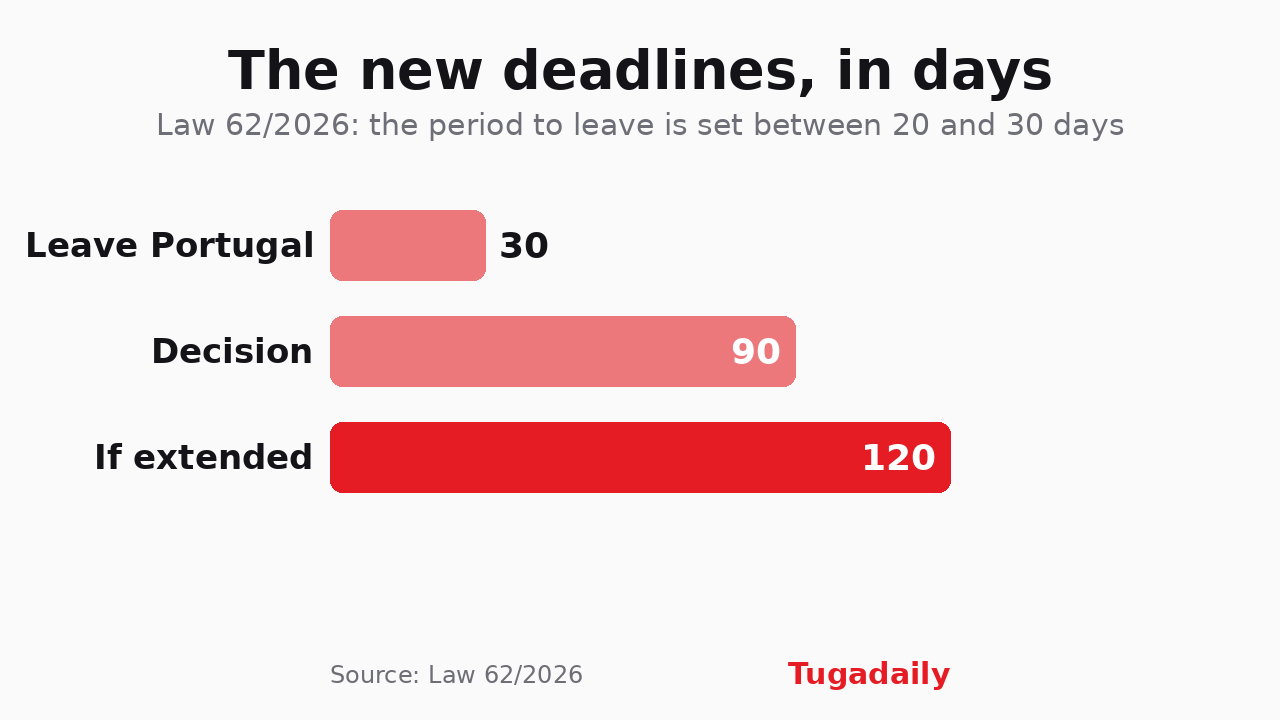
Bar chart of the deadlines in Portugal's Law 62/2026, in days: leave Portugal up to 30, in a period set between 20 and 30, decision 90, if extended 120
Immigration 15 September 2026

Portugal's new foreigners and asylum law took effect on 11 September

Law 62/2026 was published in the official gazette on 10 September and applied from the next day. It resets removal deadlines, creates a border return procedure and closes the vocational-course route to a residence permit.

For seven weeks the text sat in the president's in-tray and then in the Constitutional Court, and nothing on the ground changed. That is over. Law 62/2026 was published in the Diário da República on 10 September, and because the law says it takes effect the day after publication, it has applied since Friday 11 September. Parliament passed the decree on 17 July, the president signed it on 31 August, the prime minister countersigned on 1 September, and…

Continue reading
Passengers with luggage beside a coach on the platforms of the Sete Rios bus terminal in Lisbon
Immigration 14 September 2026

Arriving in Lisbon by coach or train? Portuguese police are running border checks at the terminals

The PSP's foreigners and borders unit says irregular arrivals by road and rail into the Lisbon and Porto metropolitan areas are rising, coming in from other European cities. For travellers, the practical bit is simple: carry your residence permit.

The route has shifted, and that is what the PSP came out to say on Sunday. Chief superintendent João Ribeiro, deputy national director and head of the National Foreigners and Borders Unit, named road and rail flows into the Lisbon and Porto metropolitan areas from other European cities as an identified risk factor — people who are irregular in another Schengen country and who keep moving between countries inside it. They arrive, he said, at the big coach…

Continue reading
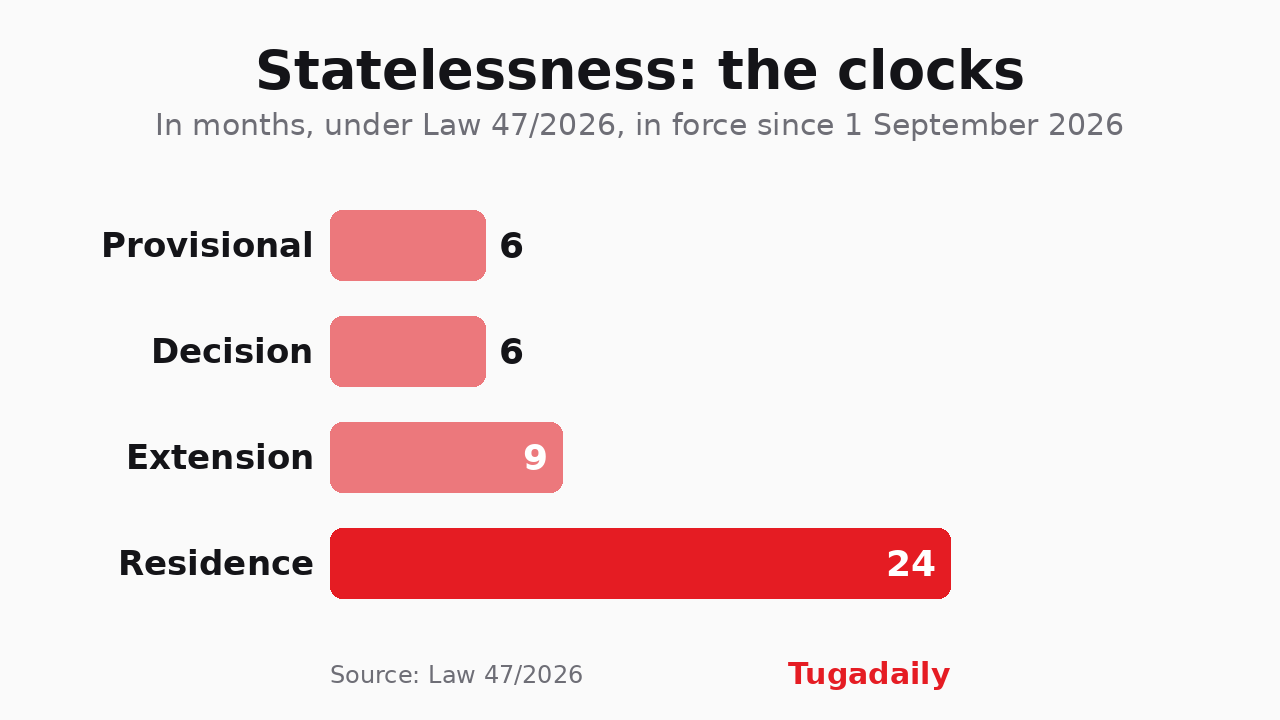
Bar chart of the deadlines in Law 47/2026, in months: a six-month provisional permit, six months to decide, nine in complex cases and a 24-month residence permit if the status is recognised
Immigration 6 September 2026

No country claims you as a citizen? Since 1 September there is a procedure, and it is free

Law 47/2026 came into force on 1 September and hands AIMA the job of recognising stateless status. Opening a case gets you a provisional residence permit for six months, and the right to work, on day one.

Portugal has recognised stateless status since 2023. What it did not have was a route to it: no authority formally in charge, no deadline, no document to hand to someone left waiting. That changed on 1 September, when Law 47/2026 of 17 August came into force and set out the procedure across seven pages. We read all seven. A stateless person, for the purposes of the law, is anyone no state considers its national. The application goes to AIMA's head office…

Continue reading
Aerial view of Lagos marina in the Algarve, with moored boats and the town around it
Immigration 4 September 2026

The Algarve came second in the world's retirement rankings (and the winner is in Panama)

Live and Invest Overseas put the Algarve ahead of Crete, Gascony, Puerto Vallarta and Tarragona in its 2026 index — and puts the cost for a couple at around $3,085 a month.

There is an American list that comes out every year and quietly moves people between continents. It is the Overseas Retirement Index, published by Live and Invest Overseas, and in the 2026 edition the Algarve placed second among the best places in the world to retire. Only Boquete, a town in the Panamanian highlands, finished ahead of it. What the Algarve beat is more interesting than the placing. It finished above Puerto Vallarta in Mexico, Gascony in…

Continue reading
The pink facade of the Belem Palace in Lisbon seen from the gardens in front, with the Portuguese flag flying to the left
Immigration 3 September 2026

Portugal's return law was signed on 31 August. What happens next turns on a 160-page ruling

President Seguro promulgated the decree overhauling reception, entry, removal and asylum rules three days after the Constitutional Court cleared it. The court also set out how the text must be read, and that reading now guides judges and officials.

It is signed. António José Seguro put his name to the decree on 31 August, the one that rewrites how foreign nationals and stateless people are received in temporary detention centres, how they enter, stay, leave or are removed from the country, and how asylum is granted. Three days passed between the Constitutional Court's ruling and the signature.

Continue reading
The Palacio Ratton in Lisbon, seat of Portugal's Constitutional Court, shot from below with the national flag flying and a red carnation blurred in the foreground
Immigration 30 August 2026

Portugal's return law clears the Constitutional Court, all eleven questions rejected

The seven judges who signed the ruling were unanimous: not one of the eleven provisions is unconstitutional. The President had sent the decree up on 7 August, and every objection fell.

Portugal's Constitutional Court ruled on Friday that there is nothing unconstitutional in the law on asylum, detention and the return of foreign nationals. Not one of the eleven provisions put in front of it. The seven judges who signed ruling 736/2026 were unanimous. The answer is quick to state and slow to read: the ruling runs to more than 160 pages, according to the court's president, João Carlos Loureiro.

Continue reading
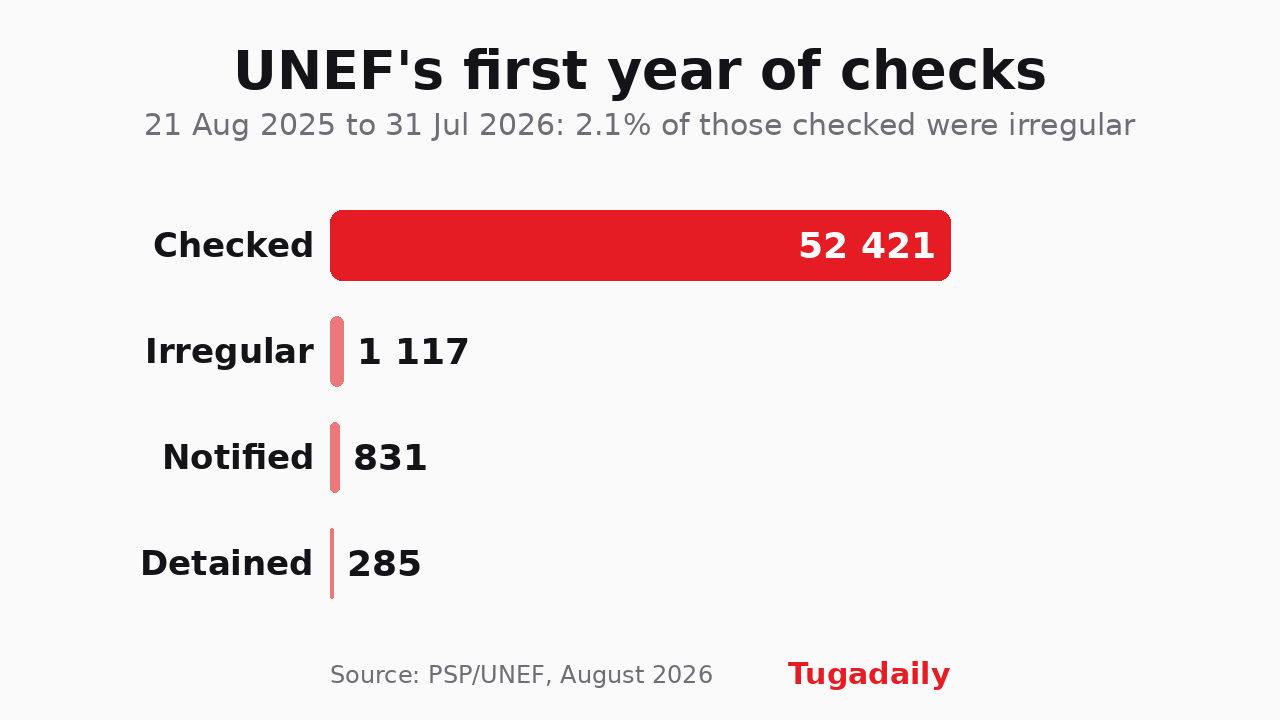
Bar chart of the UNEF's first year of checks: 52,421 foreign citizens checked, 1,117 irregular, 831 notified and 285 detained
Immigration 27 August 2026

Portugal's new border unit checked 52,421 foreigners. Just 2.1% were irregular

The PSP has released first-year figures for the UNEF: 5,397 operations between 21 August 2025 and 31 July 2026, 831 notices to leave the country and 285 arrests. Here is what that 2.1% can and cannot tell you.

Portugal's police have totted up the first year of the National Unit for Foreigners and Borders. The figure worth pausing on is not the arrests. It is the ratio. Between 21 August 2025 and 31 July 2026, the unit's foreigners and border control teams ran 5,397 inspection operations and checked 52,421 foreign citizens. Of those, 1,117 turned out to be irregular. That is 2.1%. The same operations produced 831 notices to leave the country voluntarily, 285…

Continue reading
The Loja do Cidadão public service building in Santiago do Cacém, signage above the entrance
Immigration 26 August 2026

What AIMA accepts as proof of address when your name is not on the lease

Renting a room, or living in a flat leased by someone else, means the document AIMA wants has another person's name on it. There is a route for that: a sworn declaration carrying the land-registry number and the owner's NIF, plus a tax-domicile certificate issued in the last 30 days.

One detail catches people out at an AIMA appointment, and it is not the queue. It is proof of accommodation. If you own the flat, the whole thing takes a minute. If you rent a room in a shared house, live with a relative, or hold a tenancy signed by somebody else, you have a genuine problem: the document AIMA wants to see has another person's name across the top of it. The good news is that a route exists for precisely that situation. The bad news is that…

Continue reading
Service desks at an Espaço do Cidadão government office in Portugal, with staff at the counters and people seated waiting their turn
Immigration 25 August 2026

Bringing a child to Portugal through family reunification? They have to be here on the day you file

A little-known condition on AIMA's Family Reunification of Minors platform catches a lot of families out: the child must be demonstrably on Portuguese territory on the date the application is submitted. If they are still abroad, the portal will not take it and the application has to be made in person.

If you are in Portugal and want to bring a child over through family reunification, there is a little-known condition that undoes a lot of people's planning: the child has to be demonstrably on Portuguese territory on the date the application is filed through the Family Reunification of Minors platform. It is set out in AIMA's own information note on family reunification and repeated on the Foreign Ministry's list of AIMA booking platforms, which spells…

Continue reading
People queuing at the civil registry counters in Lisbon's Campus de Justiça, with a clerk serving at counter 14
Immigration 24 August 2026

What happened to Portugal's promised nationality regulation? Eight days past the deadline, still nothing

Organic Law 1/2026 gave the government 90 days to rewrite the Portuguese Nationality Regulation. We opened the Diário da República's consolidated register on 24 August: the most recent amendment is still dated July 2025.

The government gave itself 90 days to write the instruction manual for Portugal's new nationality law. That deadline ran out on 16 August. Eight days later, the manual is still the one from 2006. We checked it the simplest way there is. We opened the consolidated register for Decreto-Lei n.º 237-A/2006, the decree that approves the Portuguese Nationality Regulation, and read the full list of instruments that have amended it since 2006. There are seven.…

Continue reading
Aerial view of the town of Carregal do Sal in the Viseu district, red-tiled houses surrounded by fields
Immigration 23 August 2026

AIMA spread its appointments around the country. Now people are paying €300 to reach them

Slots are allocated by availability rather than by where applicants live, so an Almada resident was booked into Carregal do Sal, near Viseu, for an appointment lasting minutes.

On paper it was sensible. The offices in Lisbon and Porto were overwhelmed, so spread the appointments across the country and the queues shrink. That is what AIMA did. What the plan left out was the geography of the people being seen. Slots are being handed out according to availability, not according to where the applicant lives. The result, reported by Jornal de Notícias, is people crossing half the country for procedures that take a few minutes. An…

Continue reading
The Finanças tax office building in Albufeira, with its blue tax service sign on the façade
Immigration 23 August 2026

When does Portugal start taxing your foreign income?

The 183-day rule decides whether Portugal taxes your worldwide earnings or only what you make here. What counts, what does not, and the traps in a first IRS filing.

Most people move to Portugal thinking about the lease, the school place and the NIF. The tax question surfaces the following May, when the filing window opens. By then it is too late to plan and too early to relax. Everything turns on one question: are you tax resident in Portugal? If you are, Portugal taxes your worldwide income. If you are not, it taxes only what you earned here. The main test sits in article 16 of the Portuguese Personal Income Tax…

Continue reading
The public hall of the Conservatória dos Registos Centrais in Lisbon, with people arriving, staff at the counters and rows of waiting chairs
Immigration 22 August 2026

Portugal's registries took on 47 new conservadores this month. It is the first intake in over twenty years

They started on 3 August and some were posted to the Central Registry Office in Lisbon and the Porto Central Archive, the two places where nationality applications are decided. Another 66 arrive in September. In 2025, more than 63% of registry staff were 55 or older.

If your nationality file is sitting in a Portuguese conservatória, staffing news is not usually the kind you get. This month it was. The registry and notary institute confirms that 47 new registrars started work on 3 August, the first intake into the career in more than twenty years. Twenty years is the number that matters. No conservador has been recruited in this country since before the citizen card existed, and over that period the IRN kept collecting…

Continue reading