

Arriving in Lisbon by coach or train? Portuguese police are running border checks at the terminals
The PSP's foreigners and borders unit says irregular arrivals by road and rail into the Lisbon and Porto metropolitan areas are rising, coming in from other European cities. For travellers, the practical bit is simple: carry your residence permit.
The route has shifted, and that is what the PSP came out to say on Sunday. Chief superintendent João Ribeiro, deputy national director and head of the National Foreigners and Borders Unit, named road and rail flows into the Lisbon and Porto metropolitan areas from other European cities as an identified risk factor — people who are irregular in another Schengen country and who keep moving between countries inside it.
They arrive, he said, at the big coach terminals and through the railway stations. And in those places the PSP has the power to run what it calls mobile border control.
What mobile border control is
Inside Schengen there are no border posts. That was the point of building it. What does exist, and always has, is the ability of police forces to carry out identity checks inside the territory, including in border zones and transport hubs, provided they are not systematic and do not amount to a permanent border check. That is what the Schengen Borders Code allows under its article on the exercise of police powers.
In practice a team turns up as an international coach pulls into Sete Rios or a train reaches Campanhã, asks some passengers for documents, and leaves. It is not a fixed post. It appears and it disappears, which is the whole meaning of “mobile”.
What it means if you are the one travelling
If you hold an EU passport or ID card, the conversation lasts seconds. If you are a third-country national resident in Portugal, the document that matters is your residence permit — and it is worth having it on you, rather than in a drawer at home, when you take an international coach or train. A valid permit you cannot produce turns a one-minute check into a considerably longer one.
People flying in with a final destination elsewhere in Europe fall, on the PSP’s reading, into a separate category: they enter Portugal with no intention of staying, on their way to northern Europe, where there are communities and relatives of their nationalities.
The context we already reported
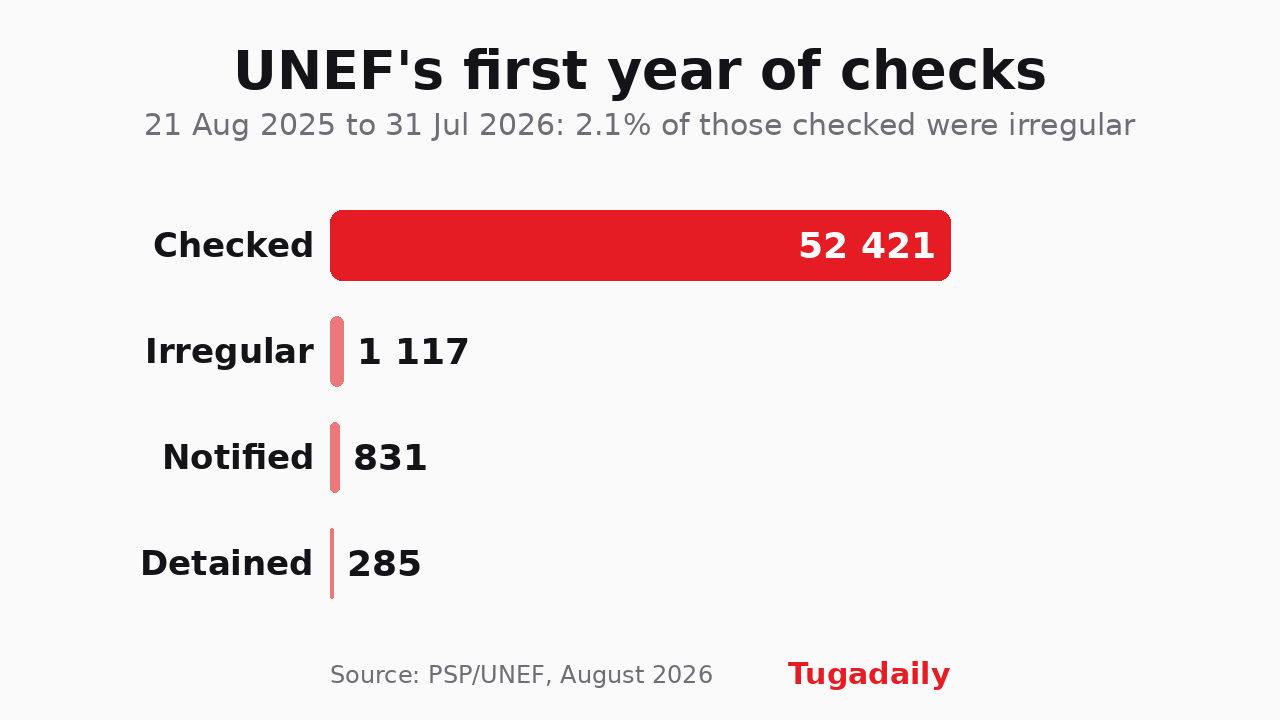
In August we went through the UNEF’s first year: 52,421 foreign nationals checked and 1,117 found to be irregular, an irregularity rate of 2.1% across 5,397 operations. The figure worth holding on to there is the denominator. The overwhelming majority of people stopped were entirely in order — which is simultaneously the argument for the checks and the argument for keeping your paperwork in your pocket.
Image: tomasz przechlewski / Wikimedia Commons (CC BY 2.0)