
Portugal's new foreigners and asylum law took effect on 11 September
Law 62/2026 was published in the official gazette on 10 September and applied from the next day. It resets removal deadlines, creates a border return procedure and closes the vocational-course route to a residence permit.
For seven weeks the text sat in the president’s in-tray and then in the Constitutional Court, and nothing on the ground changed. That is over. Law 62/2026 was published in the Diário da República on 10 September, and because the law says it takes effect the day after publication, it has applied since Friday 11 September.
Parliament passed the decree on 17 July, the president signed it on 31 August, the prime minister countersigned on 1 September, and publication followed nine days later. The Constitutional Court had cleared all eleven provisions put to it, without striking a single one.
The route that just closed
The sharpest change sits in article 92, whose fourth paragraph is repealed. A residence permit for a secondary-school student, or a student on a level 4 course, now depends on already holding a residence visa issued under the law, alongside the usual conditions of enrolment, means of support and health cover.
That matters because enrolling on a vocational course had become one of the last low-friction ways for someone already in Portugal without a residence visa to regularise from inside the country. There was a rush to enrol in the weeks before the law landed. It no longer works that way.
Article 122, which governs residence permits granted without a visa, has been narrowed too. It has not vanished. Among the situations it keeps is a permit for a foreign national with minor children of Portuguese nationality living in Portugal, provided the parent actually exercises parental responsibility and supports and educates them.
How long you have, and who can give you longer
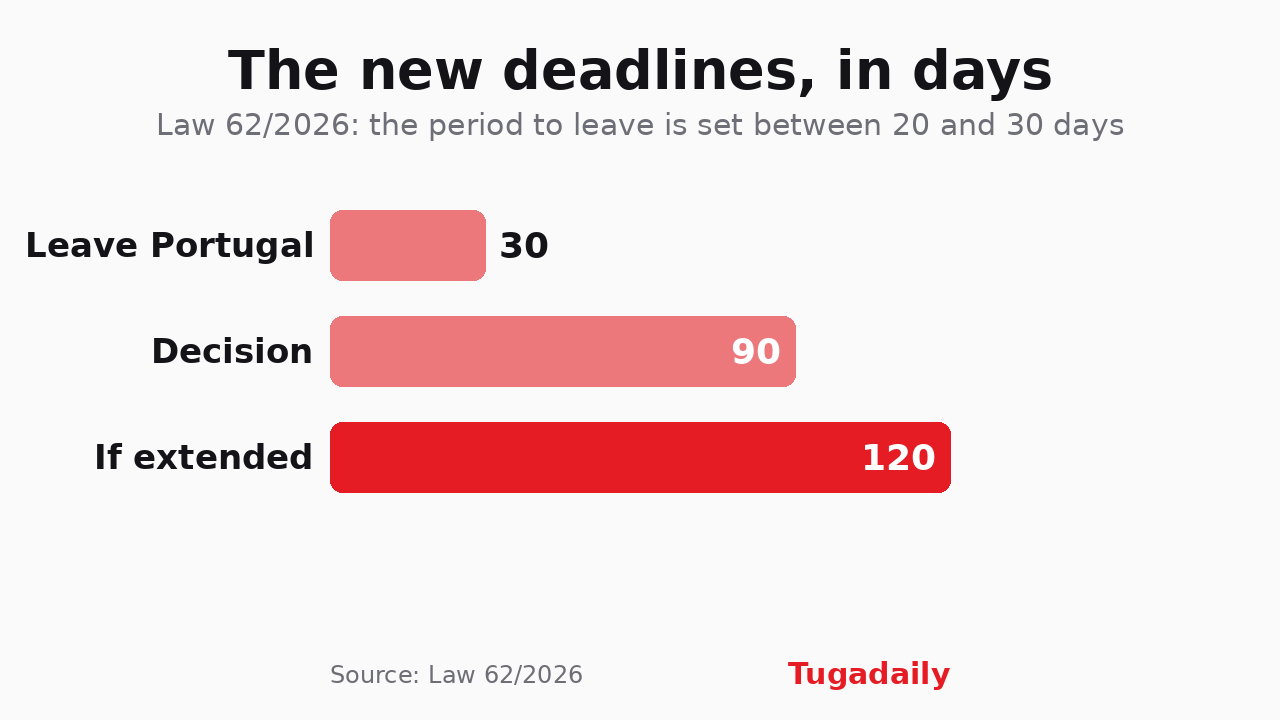
Anyone notified of an administrative decision refusing a stay or residence application, or cancelling a visa or residence title, must leave Portugal within a period set between 20 and 30 days. The national director of the PSP can extend it, weighing how long the person has lived here, whether there are children in school, other family members and social ties.
The state now has a clock of its own. A residence permit application must be decided within 90 days, extendable by a further 30 in exceptional and properly justified circumstances, such as genuine complexity. Keep a note of the date your file went in.
What else is in the package
The law also creates a screening regime for third-country nationals and a border return procedure, which applies when an application for international protection is refused at the border and the person waits in a designated place, without authorisation to enter, pending removal.
Temporary installation centres may now run wholly or partly on an open regime, allowing movement without continuous surveillance, where that suits the person’s circumstances and there is no risk of absconding or danger to public order. A new article 71-A allows the stay of admitted third-country nationals to be extended up to nine months within any twelve-month period.
All of it serves seven EU regulations and transposes two directives, including the single permit directive covering residence and work. This is the central piece of Portugal’s adaptation to the European Pact on Migration and Asylum, and it arrives two years after the country shut down the manifestação de interesse route.
Chart: Tugadaily, with data from Law 62/2026 of 10 September