
No country claims you as a citizen? Since 1 September there is a procedure, and it is free
Law 47/2026 came into force on 1 September and hands AIMA the job of recognising stateless status. Opening a case gets you a provisional residence permit for six months, and the right to work, on day one.
Portugal has recognised stateless status since 2023. What it did not have was a route to it: no authority formally in charge, no deadline, no document to hand to someone left waiting. That changed on 1 September, when Law 47/2026 of 17 August came into force and set out the procedure across seven pages. We read all seven.
A stateless person, for the purposes of the law, is anyone no state considers its national. The application goes to AIMA’s head office or any of its branches, in writing or orally, and there is a right to an interpreter in a language the applicant understands from the first minute. The process is free and legally urgent, both at AIMA and in court, should it get that far.
What you get the day you open the case
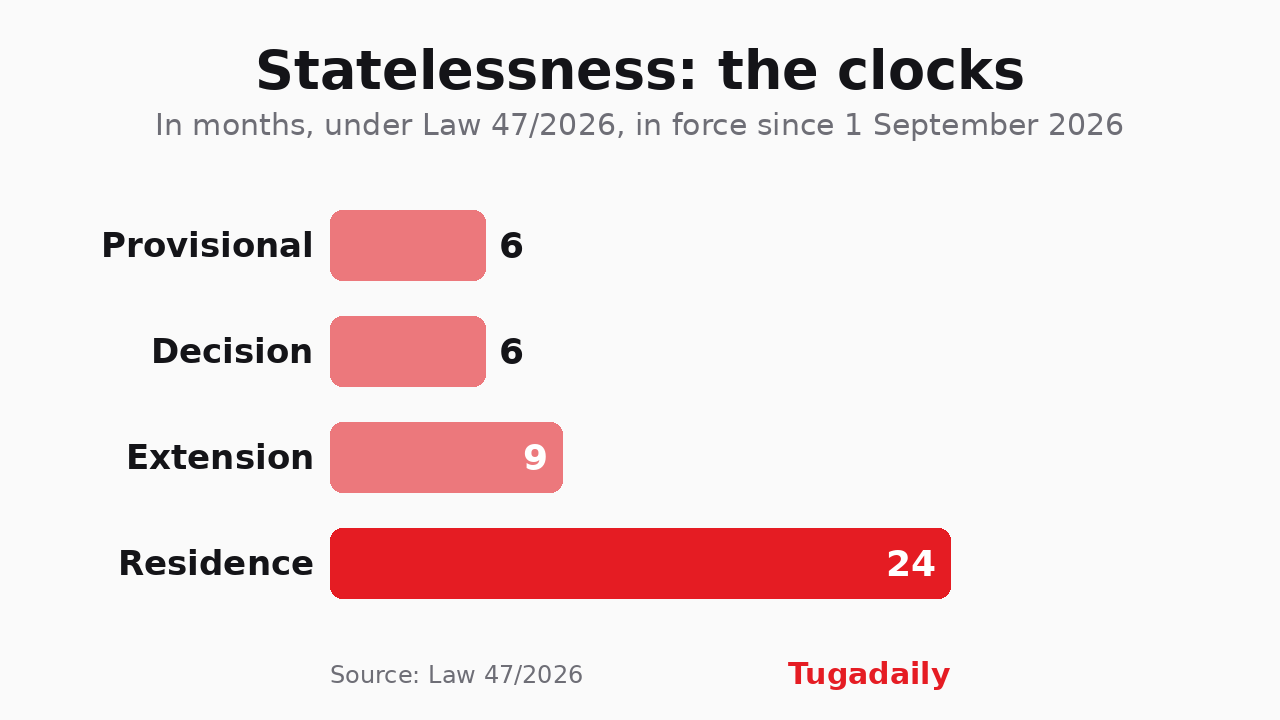
A provisional residence permit, issued immediately, valid for six months and renewable until a final decision. It carries the right to work, employed or self-employed, plus access to healthcare, education, employment and training schemes, free legal support, and access to UNHCR’s Portuguese office.
One protection is worth reading twice. Opening the case suspends any administrative or criminal proceedings for irregular entry or stay, against the applicant and against accompanying family members. If the status is recognised, those proceedings are closed for good.
How long it takes
AIMA has six months to decide from the day the case opens, extendable to nine in cases of particular complexity — and it must tell the applicant why. If, after three months, the country the applicant is connected to has not answered on nationality, the law presumes that country does not consider them a national. Before the decision lands there are ten days to respond to AIMA’s report, translated. A refusal can be challenged within 15 days, with suspensive effect and no court fees.
Once the status is recognised, the residence permit runs two years, renewable, together with a stateless person’s travel document. Holders then have the rights and duties of Portuguese citizens, minus political rights and whatever the Constitution reserves to nationals, and are entitled to Portugal’s diplomatic and consular protection.
It is a small piece slotting into a year in which immigration law has mostly moved the other way, between the status Parliament approved in July and the returns law signed on 31 August.
Chart: Tugadaily, with data from Law 47/2026