
Portugal offered 207,086 teenagers a €30 book voucher. About one in five spent it
The second edition of the cheque-livro closed on 31 August with 45,075 vouchers redeemed. The ministry led with an 85.9% usage rate, which measures something much narrower.
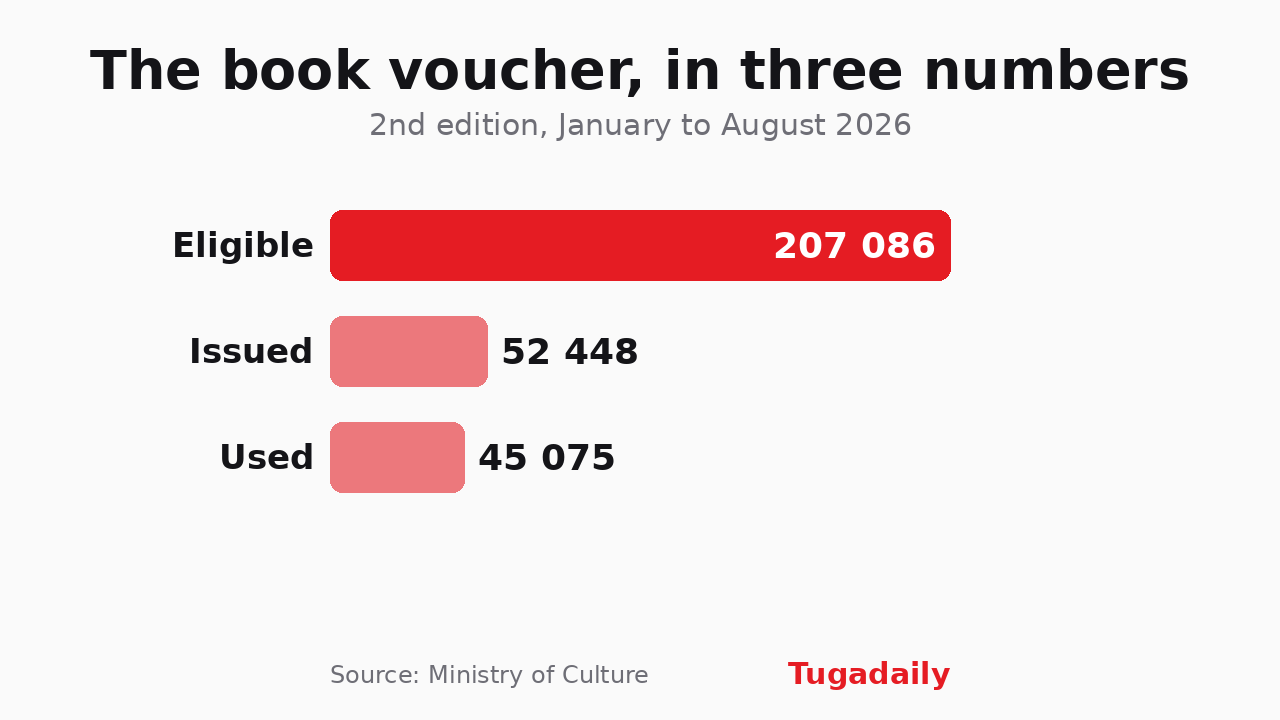
Portugal’s cheque-livro scheme closed its second edition on Monday, 31 August, and the Ministry of Culture, Youth and Sport put the figures out a day later. It issued 52,448 vouchers worth €30 each. Of those, 45,075 were spent, pushing the redemption rate from 82.4% to 85.9%.
That is the headline number, and it is a good one. It also measures something quite narrow: of every hundred young people who asked for the voucher, nearly 86 walked into a bookshop and used it. It says nothing about how many asked.
The denominator changes the picture
The scheme was open to anyone living in Portugal born in 2007 or 2008 — 207,086 people, on the ministry’s own count. Measured against that, the 52,448 vouchers issued are 25.3%. The 45,075 actually spent are 21.8%.
Put plainly, three in four eligible teenagers never claimed the €30 at all. Money that was never claimed was never spent.
The previous edition was worse. Between November 2024 and July 2025, from an estimated pool of 220,000, roughly 47,000 vouchers went out and about 35,000 were used. So the improvement is real: 4,797 more issued, 5,805 more redeemed.
A smaller network, a better result
Two changes help explain that. The voucher went from €20 to €30, and it became possible to spend it on a cheaper book — previously it was not, which left anyone wanting a paperback staring at credit they could not use.
The network shrank at the same time, from 128 bookshops and 306 outlets to 95 bookshops and 299 outlets nationwide. The full list by district sits on the programme’s own portal, and the access rules — Citizen Card or Chave Móvel Digital, non-school books published in Portugal, resident foreign nationals included — are set out on the IPDJ’s official page.
The original deadline was 30 June. It was extended to 31 August with only days to spare, at a point when 40,663 vouchers had been issued, and those two extra months added almost 12,000 more. Lisbon, Maia, Vila Nova de Gaia, Porto and Braga had the strongest take-up.
DGLAB has until 31 October to file its final report, and only then will the ministry decide whether there is a third edition. That decision lands squarely on the cohort now taking up second-round university places and the one starting the 2026/2027 school year.
Chart: Tugadaily · data from the Ministry of Culture, Youth and Sport