
Portugal's readers are reading more and buying less
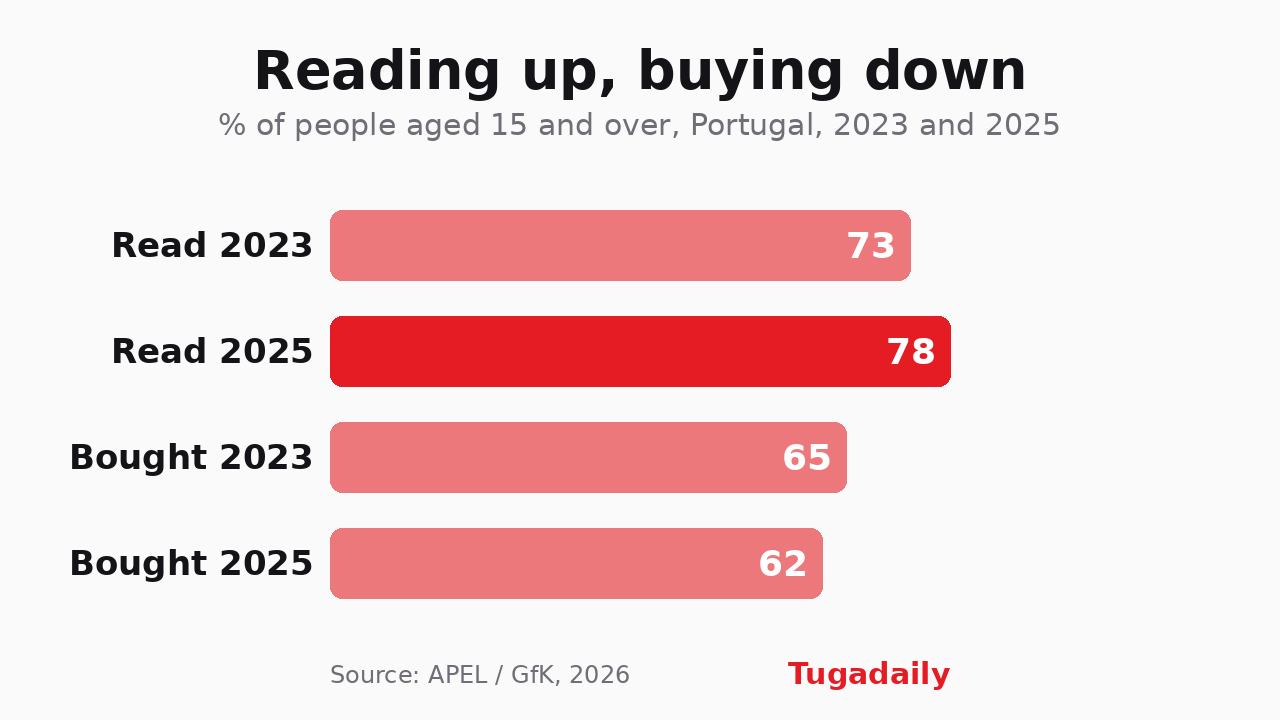
An APEL study with Nielsen GfK puts the reading rate at 78%, its highest in three years, up from 73% in 2023. Over the same period the share of people who bought at least one book fell from 65% to 62%, and the average per buyer dropped from 7.5 books to 6.9.
More people are reading. Fewer people are paying for it. Both sentences come out of the same study, presented this week at the opening of Book 2.0 at the Centro Cultural de Belém, and the gap between them is the interesting part.
Start with the good news. The reading rate went from 73% in 2023 to 76% in 2024 and 78% last year, which is the share of people aged 15 and over who say they read at least one book that year, and the highest figure of the three. The average reader got through eight books in 2025, up from 7.2 the year before.
Now the other column. The share who bought at least one book sat at 62%, down from 65% in 2023. Books per buyer have fallen every year: 7.5, then 7, then 6.9. New readers arrived. New customers did not.
This does not contradict the market figures, and that is where the reading gets interesting. Measured on the retail panel, the sector is running about 17% above 2023. The money grew. The number of books each household carries home did not keep pace.
So where are the books coming from
This is the finding that deserved more attention than it got. Among people who read digitally, 68% use free content. Of those, 64% go through cloud storage platforms, 30% through WhatsApp and 15% through Telegram.
Look at what that actually describes. It is not a pirate site buried somewhere offshore. It is a file moving from phone to phone in a group chat, in the same thread where people arrange dinner. The publishers’ association accepts that some of these channels carry perfectly legitimate uses, from authorised lending to open access, and that is precisely what makes it awkward to police: the line does not sit on a platform, it sits inside a habit.
The competition for an evening
The survey also asked what people do with their free time. Seeing friends leads on 91%, social media follows on 85%, cinema and streaming on 75%, sport on 66%. Reading for pleasure comes next, on 62%.
Among those who do not read, the most cited obstacle is not a shortage of hours. It is a lack of interest, on 43%, ahead of lack of time on 38% and a preference for other activities on 33%.
The trade has a list of asks ready: a bigger book voucher scheme, a full income-tax deduction on the VAT paid for books, support for opening bookshops, a rotating Portuguese Book Capital. Every one of those works on supply. Read carefully, the study says a good part of the problem is on the demand side, in time and attention, and nobody has worked out how to subsidise those.
There is evidence the audience still turns up when books leave the shop, mind. The Belém book festival drew 400 authors and 123 stalls with free entry, and the New Seven Wonders vote showed that rallying the country around culture still works. Converting that into sales is the open question.
By Lucy Bennett
Chart: Tugadaily · data APEL / Nielsen GfK