Portugal's clocks go back an hour tonight. On Sunday, Lisbon's sun sets at 17:44
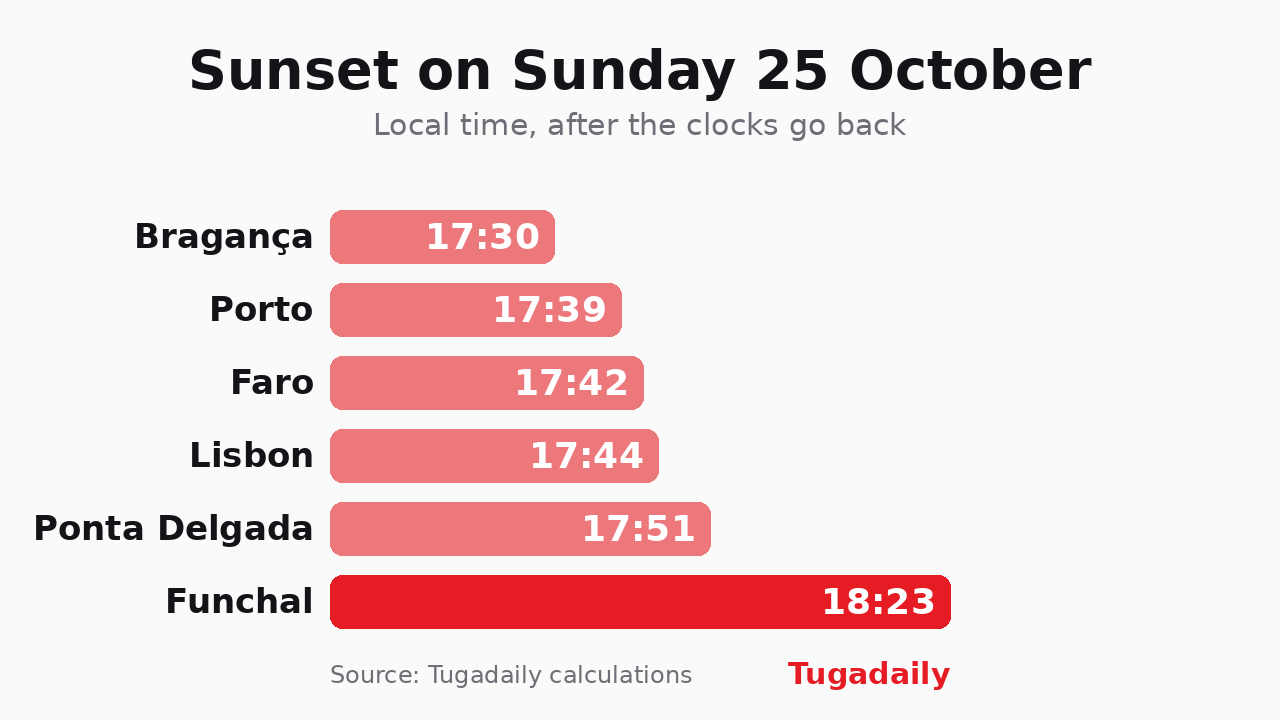
In the early hours of Sunday 25 October, 2:00 becomes 1:00 on the mainland and in Madeira, and 1:00 becomes midnight in the Azores. We worked out sunset in six cities: on Sunday it comes an hour earlier than on Saturday, from 17:30 in Bragança to 18:23 in Funchal.
You get an extra hour in bed tonight. In the early hours of Sunday 25 October, when clocks on the mainland and in Madeira reach 2:00, they go back to 1:00. The Azores change at the same universal moment, which there means 1:00 becomes midnight.
Phones and laptops will sort themselves out. The oven, the microwave, the car dashboard and the kitchen wall clock that nobody has touched since March are on you.
What changes in the evening
The bit you notice is the light. We ran the sunset times for six cities from each one’s solar ephemeris, and the jump between Saturday and Sunday is exactly an hour. In Lisbon the sun sets at around 18:45 on Saturday and 17:44 on Sunday.
Bragança goes dark first, at about 17:30. Porto (17:39), Faro (17:42) and Ponta Delgada (17:51, Azores time) sit in the middle. Funchal holds on longest, with sunset at roughly 18:23.
Mornings get the light back. If you leave home in Lisbon at 7:30, you are no longer leaving in the dark: sunrise moves from about 7:55 to 6:56. The evenings keep shrinking until the solstice, though. On 21 December Lisbon’s sunset is around 17:18, and Bragança’s comes before 17:00.
Why Europe still changes the clocks
It is an EU rule. Directive 2000/84/EC has every member state change on the last Sunday of October and the last Sunday of March, at 1:00 Universal Time, all at once. That is why summer time comes back on 28 March 2027.
It was supposed to stop. In 2018, after a public consultation that drew 4.6 million responses, the European Commission proposed ending the switch, and the European Parliament voted in 2019 to end it from 2021. The governments never agreed in the Council, and the file has sat there since.
Portugal’s government has consistently backed keeping things as they are. The United States has been having the same argument, and we reported on how close Congress came to locking in permanent daylight saving time. In Brussels, the Commission ordered a study of ten scenarios in February, permanent summer or winter time among them, with results due by the end of 2026.
Until something actually changes, it is the usual drill: a longer lie-in on Sunday morning, and a much shorter afternoon.
Chart: Tugadaily, own solar ephemeris calculations