The UK now wants every home able to get through three days on its own
Britain's new Be Ready campaign asks households to keep enough to last three days without services: 3 litres of drinking water per person per day, food that needs no fridge, a battery radio, a torch, cash and paper copies of documents. It is the first stage of a three-year campaign, modelled on France, Ireland and the Netherlands.
The UK government wants every household to be able to cope for three days on its own if the power, water, phones or internet go down. The campaign is called Be Ready, and the Cabinet Office launched it on 22 October as the first stage of a three-year push that will build gradually, with radio and social media advertising aimed at families with young children and older people.
London’s reasons are specific. Last winter’s storms and this summer’s wildfires cut phone signal, water and power to whole areas. Cyber attacks are on the list too.
What’s on the checklist
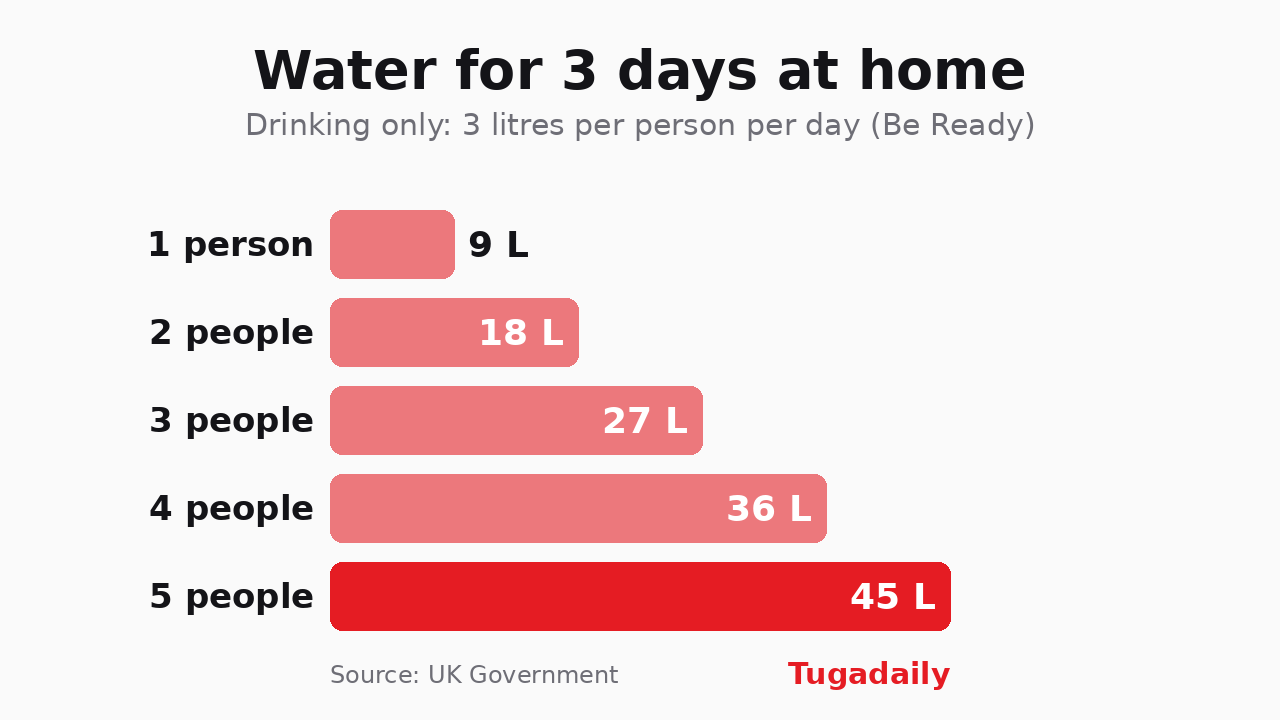
The water is the easy sum. The guidance asks for 3 litres per person per day, for drinking alone. Over three days, a family of four needs 36 litres put aside, and cooking and washing come on top of that.
The rest of the official checklist is short and practical. Food that needs neither a fridge nor a hob, such as tins and dried fruit (ideally things the family already eats). A torch and batteries rather than candles. A battery or wind-up radio, with your stations’ frequencies written down. A charged power bank. Blankets and warm clothes, because a house goes cold quickly once the heating stops.
It also asks for some cash in case card payments and cash machines fail, paper copies of documents and emergency contacts, medicines and a first-aid kit, nappies and ready-made formula for babies, and pet food.
Nobody is being told to buy it all this weekend. The suggestion is to add an item or two on normal shopping trips and check use-by dates every six months.
Catching up with the neighbours
The UK admits it is late. The government’s own release says the three-day rule is already used in France, Ireland and the Netherlands, and that more than five hundred organisations, from charities to businesses, have signed up to spread the message.
Portugal’s civil protection authority has been recommending a very similar 72-hour kit for months: water, food, radio, torch, documents and a little cash. What the country still lacks is a national campaign on this scale, a gap we described when we reported that Portugal has no guidance telling citizens what to do in a crisis. Anyone who sat through the Iberian blackout of April 2025 knows exactly what a battery radio is for.
Chart: Tugadaily, with UK Government data