
Portugal plans to double its energy storage by 2030. There are 20 days to say something
The National Energy Storage Strategy sets 6.9 GW installed by 2030 and 9.76 GW by 2040. It opened for public comment on Saturday on Participa.pt and stays open for 20 days.
Storing electricity is the dull problem that decides whether renewables are any use at seven in the evening. Portugal already makes plenty of sun and wind. What it does not yet have is somewhere to keep them until they are needed.
The National Energy Storage Strategy, known here as the ENAE, is the attempt to fix that with figures rather than intentions, and it opened for public consultation on Saturday on the Participa.pt portal, where it stays open for 20 days. Any resident, company or association can file a comment.
How much energy storage will Portugal have by 2030 and 2040?
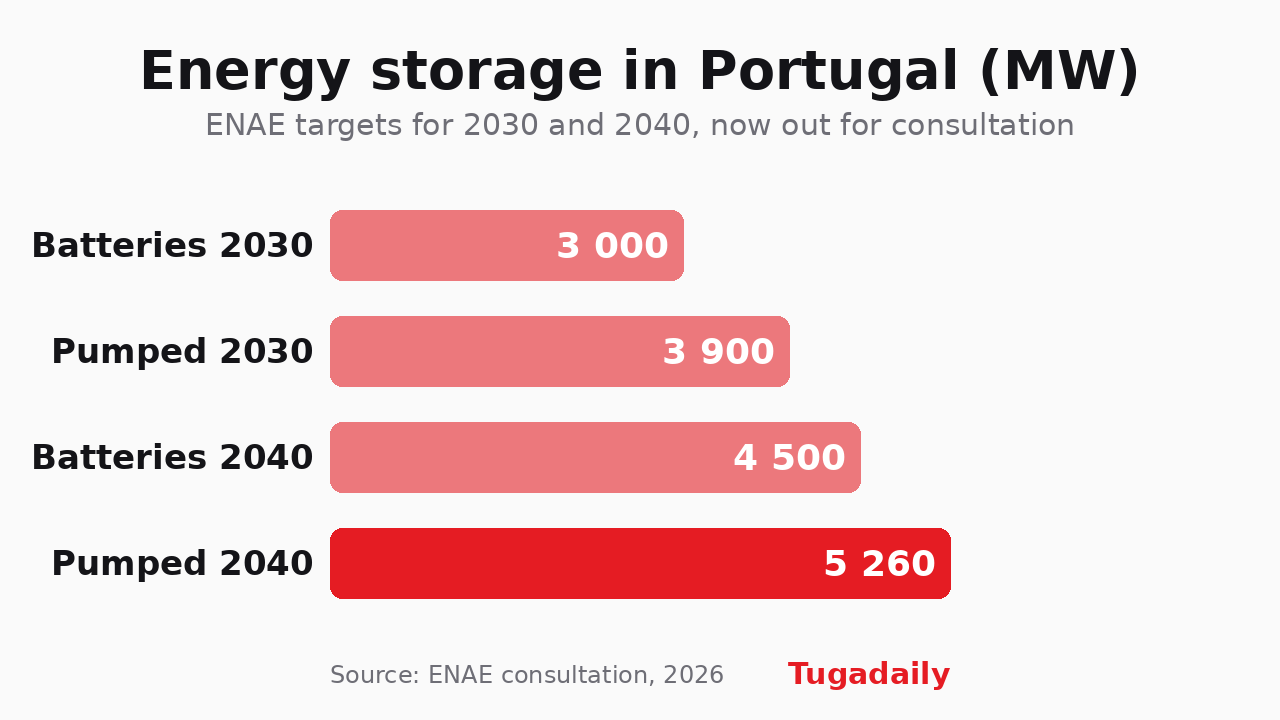
By 2030 the strategy sets at least 3 GW of batteries and 3.9 GW of pumped hydro — 6.9 GW in total, close to double what is installed today. By 2040 that rises to 4.5 GW of batteries and 5.26 GW of pumped hydro, or 9.76 GW.
Look at the split by technology. Between 2030 and 2040 batteries climb from 3 to 4.5 GW, a rise of half again, while pumped hydro — the old and well-understood answer, pump water uphill into a reservoir when there is spare power and let it fall when there is not — goes from 3.9 to 5.26 GW, about 35%. Batteries are the faster-growing half, and that is the real shift.
Four fronts
The action plan is organised around four areas: economic value and participation in system services, the regulatory framework, simplifying grid connection, and technological innovation. Developers talk most about the third one, because connecting a project to the grid is currently the slow step.
The government had already announced in June that two battery auctions would run in September, and the strategy is the umbrella those pieces sit under. It is worth reading alongside the map of renewable acceleration zones approved this month: one says where you may generate, the other says where you may store.
Why it matters to you
Two reasons. The first is your bill: with nowhere to store a surplus, it gets wasted or sold cheap, and at peak hours the country imports expensively instead. The second is the new demand turning up — the data centres that want to set up here draw power continuously, not only when the sun is out.
Twenty days is not long for a document with targets running to 2040. It is the time there is.
Chart: Tugadaily, with data from the National Energy Storage Strategy