
Portugal has mapped 800-plus places for solar and wind (and half its councils are not on the list)
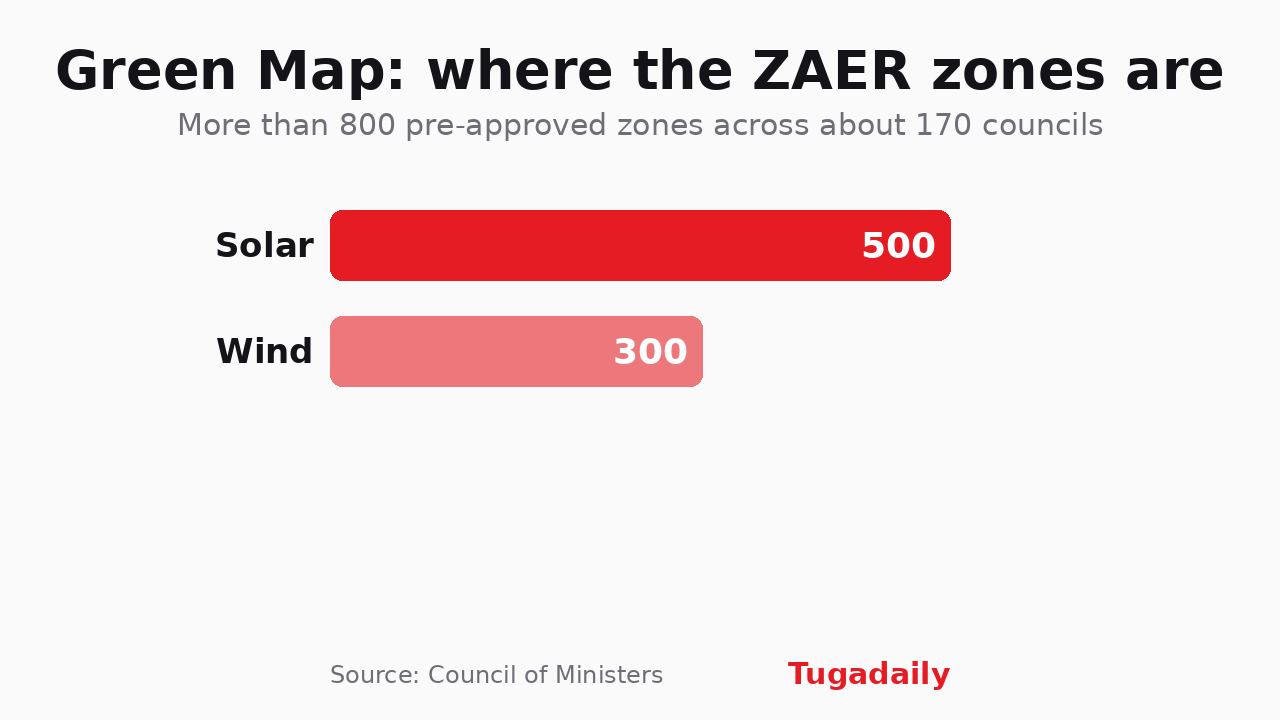
Around 500 zones are earmarked for solar and 300 for onshore wind across more than 147 of the mainland's 278 municipalities, each capped at 1% of its own area. Inside them, licensing runs on a shorter clock.
Developers, town halls and environmental groups have spent years arguing about the same thing from opposite sides of the table: nobody could say with any confidence where Portugal actually wanted its solar and wind farms. This week the government answered with a map.
On Thursday the Council of Ministers signed off more than 800 renewable acceleration zones spread across more than 147 mainland municipalities. That figure is the government’s own, and it leaves over half of the mainland’s 278 councils off the map entirely. About 500 are earmarked for photovoltaic solar and about 300 for onshore wind. Within each council that does appear, take-up is capped at 1% of its area, which tells you how narrow the filter was.
The programme was published on 25 August as Council of Ministers Resolution 172-A/2026 in the Diário da República. That publication is what makes it binding on public bodies.
What actually changes for a developer
The change is administrative, and that is precisely why it matters. A project proposed inside one of these zones goes through a shorter route: tighter licensing deadlines and, in certain cases, no project-by-project environmental impact assessment, because the strategic environmental assessment was already done upstream for the whole zone.
This is not planning permission. Designating 800 areas does not mean 800 power plants have been waved through. It means anyone building there stops repeating work the state has already finished.
Being off the map is not a no
The Ministry of Environment and Energy was blunt about this when the public consultation opened in June: the zones do not rule out projects elsewhere in the country, they act as preferred locations that steer investment towards land with lower environmental sensitivity and a grid connection close by. Everywhere else, the ordinary and slower route still applies.
The technical work came from an independent team led by Maria do Rosário Partidário, weighing environmental sensitivity, energy potential, spatial planning and distance to the grid. Protected land, farmland, water resources, heritage sites and defence requirements were screened out. The instrument transposes the EU’s RED III directive and is a commitment under Portugal’s recovery plan.
The hurry makes sense in context. Solar has already become the country’s single largest source of electricity in July, and €1.6 billion has just been committed to rebuilding the distribution grid. The bottleneck stopped being the technology a while ago. It is the years between an investment proposal and a blade going up.
The real test comes next. A map fixes paperwork. It does not fix grid capacity, and it will not persuade a village that does not want one at the end of the road.
Chart: Tugadaily · data from the Council of Ministers