
Three northern fires burnt 5,200 hectares. One Arouca firefighter is still in intensive care
We added up the burnt-area figures councils and Civil Protection gave for Torre de Moncorvo, Arouca and Santo Tirso. Not a single house burned in Arouca, but four firefighters went off the road into a 150-metre ravine on their way to the fire, and one is being moved to Gaia for surgery.
A week ago we wrote about three fires tying up almost a thousand crew at once in Torre de Moncorvo, Arouca and Santo Tirso. The fires went out, the news trucks left, and nobody did the simple sum: how much did all of that actually burn.
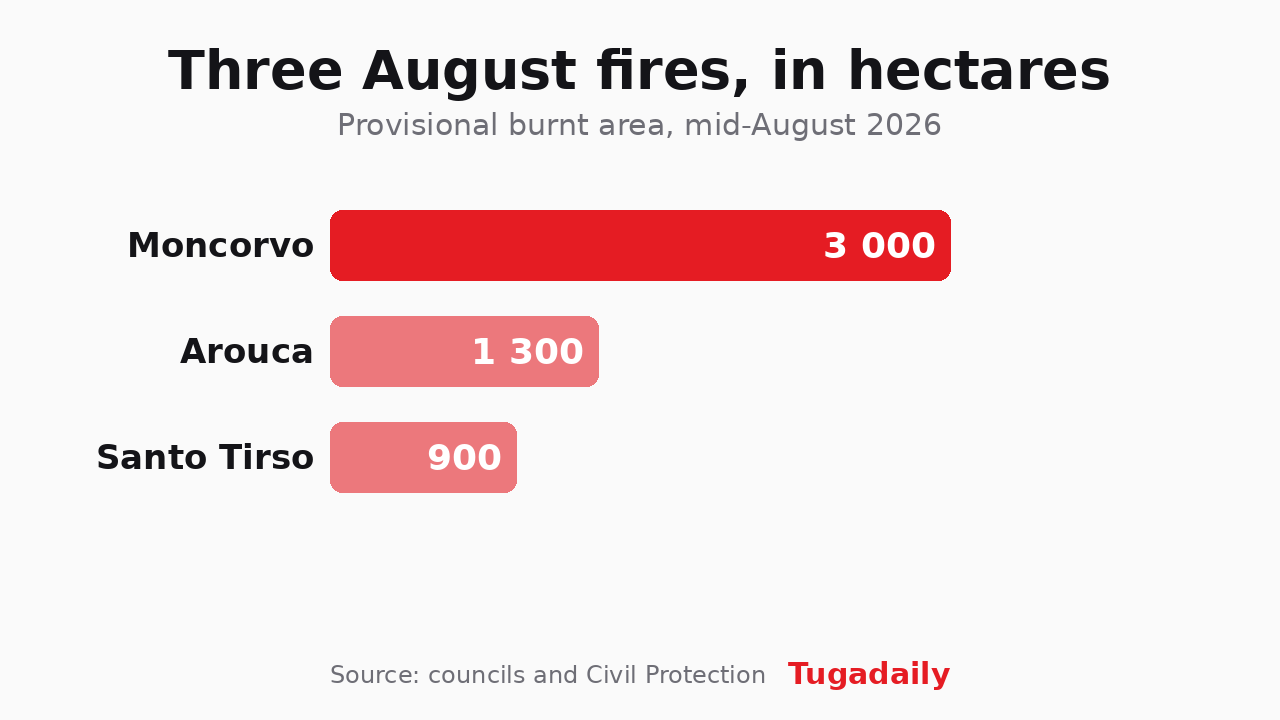
So we did it, adding up the figures each council and Civil Protection released as the fires were brought under control. It comes to roughly 5,200 hectares.
By far the biggest was Cabeça Boa, in Torre de Moncorvo, which burned for several days from the weekend of 15 and 16 August. The council put it at more than two thousand hectares inside its own municipality, mostly around Lousa and Cabeça Boa, and more than three thousand once the fire crossed into neighbouring Carrazeda de Ansiães. Around 400 of those hectares were farmland and cork oak rather than scrub, which in that part of the Douro means somebody’s income.
Arouca lost more than 1,300 hectares of forest and scrub, nearly all of it in the municipality but some already over the district line in São Pedro do Sul. And at Rebordões, in Santo Tirso, 900 hectares burned in a fire that ran to four fronts and took about fifty hours to bring under control, fought on a very steep slope in high heat and an easterly wind.
What survived in Arouca
The thing worth holding on to in Arouca is what did not happen. On the council’s initial assessment, no houses, barns or other buildings burned, and no livestock was lost. In a fire with four active fronts, more than 650 crew on the ground at once, 200 vehicles and nine aircraft, that is a line you do not often get to write.
The cost landed somewhere else. In the early hours of Wednesday a vehicle carrying four Arouca volunteer firefighters to the fire left the road and fell into a ravine 150 metres deep. They were aged between 31 and 54.
One has been discharged and is recovering at home. Two remain at Hospital São Sebastião in Santa Maria da Feira, where the hospital says both are improving steadily. The fourth, the 54-year-old, is still in intensive care with a guarded prognosis and is being transferred to Hospital Eduardo Santos Silva in Gaia for cardiothoracic surgery that Feira is not equipped to perform. He returns once he is stable.
Where this sits in the year
Five thousand two hundred hectares in three fires is a lot for five days and very little next to what 2026 could have been. ICNF figures put the mainland at 6,666 rural fires and 63,347 hectares burned up to 19 August. As we reported, this year has more fires and far less burnt area than 2025 — which also means one bad week is all it takes for that gap to close.
The definitive numbers, with satellite-mapped areas and an established cause for each fire, only arrive in the provisional reports on the SGIFR portal and from ICNF. We will come back to these three when the causes are known.
Chart: Tugadaily · data from the councils and Civil Protection