
Three fires in the north held 968 crew on Tuesday, and none was contained by nightfall
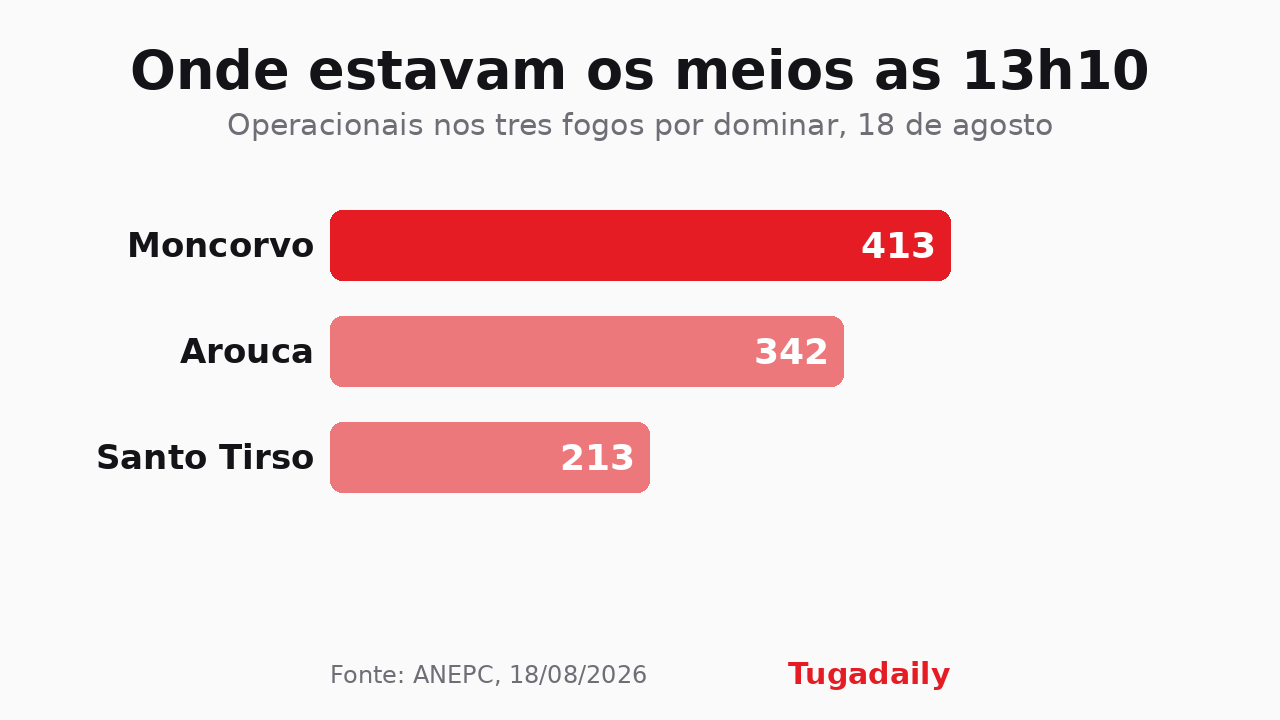
The fire at Cabeça Boa, in Torre de Moncorvo, drew 413 personnel, 135 vehicles and five aircraft on its own. Arouca and Santo Tirso accounted for the rest, while nine districts stayed under an orange weather warning until 6pm.
Nearly a thousand firefighters were tied up on three fires on Tuesday, and not one of them was under control by the end of the afternoon. The largest was burning at Cabeça Boa, in the Torre de Moncorvo district of Bragança, where at 1.10pm the tally stood at 413 personnel, 135 vehicles and five aircraft — more resources than any other incident in the country.
In Arouca, in the Aveiro district, a fire that began on Monday night in the parishes of Cabreiros and Albergaria da Serra was holding 342 emergency and security personnel, 103 vehicles and seven aircraft. The third, at Rebordões in Santo Tirso, had 213 crew and 67 vehicles. Add them up and it comes to 968 people working three fronts that sit less than two hours’ drive from one another.
Why mid-August is the dangerous stretch
Heat built again across the north and the interior, and IPMA kept nine mainland districts under an orange warning until 6pm on Tuesday. That combination — high temperature, low humidity, wind that swings direction in the early afternoon — is what turns a contained incident into a reignition in the space of minutes.
None of this landed on healthy ground. July was the driest month of the century here and drought reached the whole mainland, curing the fuel long before August arrived. Nor is this only a Portuguese problem: half the EU’s territory was in drought during July, and more has burned across Europe this year than in the whole of last year.
If you live near one of the fronts
Keep windows and doors shut so smoke stays out, park facing the exit, and get your essentials together before anyone tells you to leave. Do not drive up forest tracks to look at the fire — every car stopped on a narrow lane is an engine that cannot get through. Keep 112 for emergencies so the lines stay clear.
How this reads on Wednesday depends on the wind overnight. That is the window when temperature drops, humidity climbs and crews try to close the perimeters, and it is also the window when the aircraft cannot fly.
Chart: Tugadaily · data ANEPC