
Western Europe just had its hottest summer on record (and Portugal is not on the list)
Copernicus closed the books on August: western Europe beat its 2003 record by more than half a degree. Portugal sits inside the box that produced the record, yet appears in none of the bulletin's lists of countries that set one.
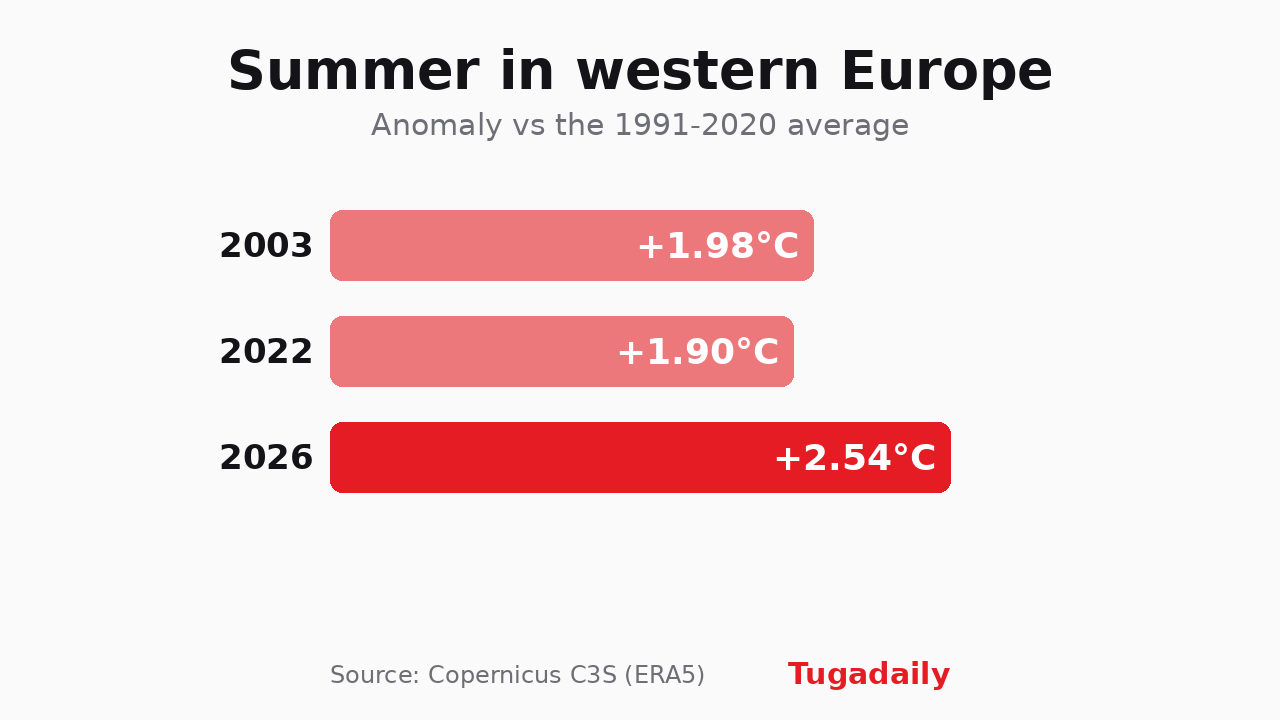
Summer 2026 was the warmest ever measured in western Europe. The June-to-August average across the region came in at 21.69C, which is 2.54C above the 1991-2020 norm, and the Copernicus bulletin published on Thursday shows by how much it won: the previous record, from 2003, stood at 1.98C above average. It fell by more than half a degree.
That comparison is what changes the meaning of the number. In 2003 the European summer was a freak, a spike surrounded by seasons that were mostly cooler than average. Not this time. Every western European summer since 2015 has run above average, and 2022 had already come close to the 2003 mark.
So where does Portugal sit in this?
The box Copernicus uses for “western Europe” runs from 11 degrees west to 15 degrees east and from 37 to 55 degrees north. Mainland Portugal fits inside it, Sagres to Melgaço. The regional record is ours too.
What does not appear anywhere in the bulletin is the country’s name. When Copernicus lists the national weather services that confirmed a record-hot summer, seven come up: France, the UK, Ireland, the Netherlands, Belgium, Spain and Austria. When it describes where ERA5 puts the warmest summer since at least 1979, it names virtually all of England, Wales and Belgium, plus most of France, Spain, Italy, Switzerland and Austria. Portugal is absent from both lists.
This is not a contradiction. The box is regional, and the fiercest heat concentrated over France and north-eastern Spain, where anomalies reached 4 to 5C. But it is an absence nobody is going to explain, because the national bulletin that would explain it does not yet exist. As of Thursday the IPMA index of monthly climate bulletins still ended at July, the month that was the driest of the century in Portugal.
The rest of the August numbers
Globally, August 2026 was the warmest month ever measured, tied with July 2023 at 16.96C against 16.95C, a gap of under one hundredth of a degree. It ran 1.65C above the estimated 1850-1900 average, the first month above 1.5C since November 2025.
There was also an oddity that almost never happens. August came in 0.06C warmer than July, and July is normally the warmest calendar month on the planet. Since 1940, August has beaten July in the same year only four other times: 1945, 1951, 1955 and 1985.
At sea, the average surface temperature outside the polar regions reached 21.07C, the highest ever recorded in an August and the joint-highest in any month, matching March 2024. The absolute daily high of 21.11C landed on 24 and 25 August, and every calendar day since 19 June has broken its own record, a climb we caught while the month was still running. For Europe as a whole the season was the third-warmest, behind 2024 and 2022, with August fourth. What pushed the season up was June, the second-warmest on record; July managed only 11th.
Copernicus also expects the developing El Niño to strengthen past the 2023 event, which raises the odds of high global temperatures through the rest of the year. A fuller analysis of Europe’s summer is promised for late September.
Chart: Tugadaily, with data from Copernicus C3S/ECMWF (ERA5)