
Half the EU spent July in drought, and this year has already burned past last year
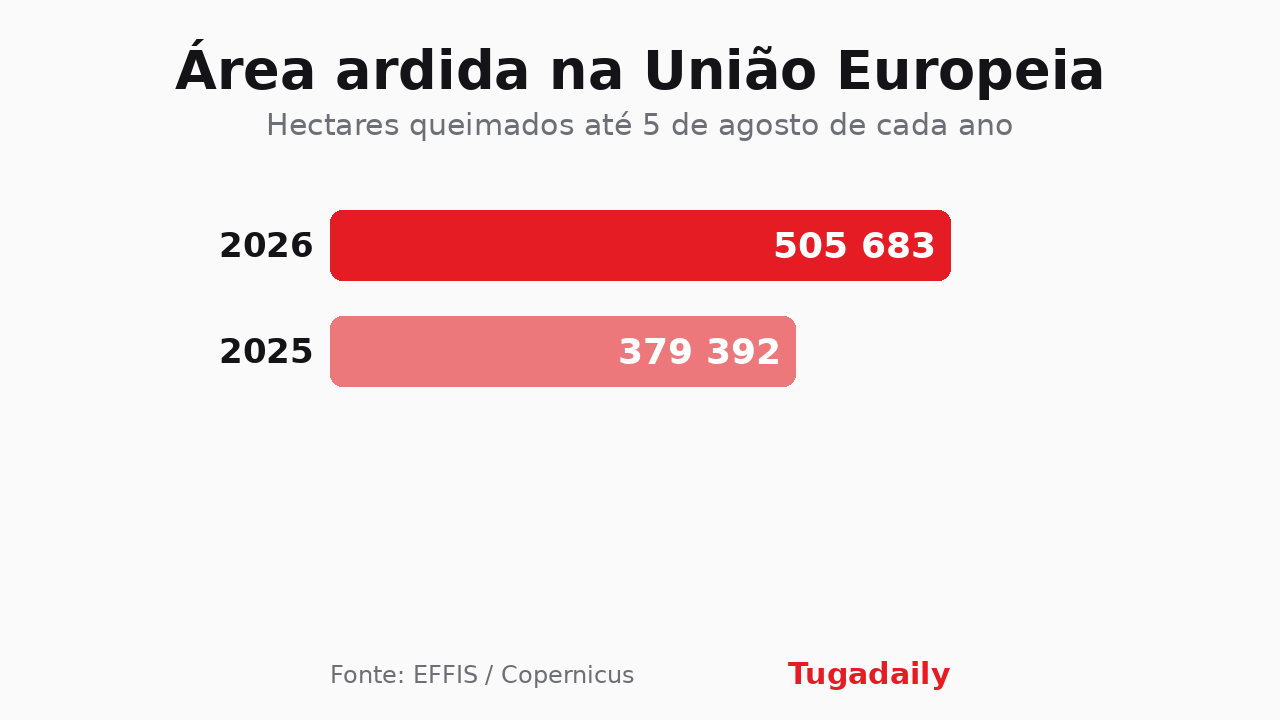
A European Commission Joint Research Centre bulletin published on 12 August puts 50% of EU and UK territory under some level of drought in July, with 505,683 hectares burned across the EU by 5 August against 379,392 on the same date in 2025.
Half of the European Union and the UK sat under some level of drought through July. That figure comes from the bulletin the European Commission’s Joint Research Centre published on 12 August, and it arrives with a harder one beside it: 505,683 hectares had burned across the EU by 5 August, against 379,392 by the same date last year.
The two scales are worth separating. That 50% counts all three drought levels together — watch, warning and alert. Alert is the serious one. It means rainfall and soil moisture have both stayed low long enough that vegetation is visibly stressed and crops are taking damage, and in July it covered 9% of the territory.
Is that a lot? The bulletin offers two yardsticks. In 2018 and 2022, summers half of Europe still talks about, drought at the same point in the year reached 54% and 60% of the territory. So 2026 is not the worst year on record. On alert-level land, though, this year’s 9% sits close to 2022’s 11% and well above the 3% recorded in 2018.
The rivers are the visible part
Four of Europe’s great rivers — the Loire, the Po, the Rhine and the Danube — hit record low levels in August. That is not scenery. Danube navigation has been disrupted in Hungary and Romania. In France, nuclear output fell for want of cooling water. In northern Italy, the Po basin is back under the hydrological stress it knows too well.
There is a human cost still being counted, too. The World Health Organization reported more than 10,000 excess deaths in five countries alone during this summer’s most extreme heat episodes.
Where Portugal sits in this
Europe’s response is measured in activations of the Copernicus emergency service, which turns out fast maps for the people on the ground. Since the start of June there have been 30 wildfire activations, and Portugal is on that list alongside Greece, Spain, France, the UK, Germany, Croatia, Tunisia, Serbia, Albania and Greenland. Five are still open.
Domestic numbers were already climbing: burnt area passed 30,000 hectares in July, and the month closed as the driest July of the century. Most of the last month’s large fires, though, were concentrated in Spain and France.
The warning at the end of the bulletin is the part that matters for the coming weeks. Forecasts point to hotter, drier than average conditions across central and western Europe into September, with continued heatwave risk in August — although, unlike the rest of the continent, the Mediterranean is expected to be wetter than usual. Last year closed on 1,034,552 hectares, the worst on record for the EU, and the scientists note that it was precisely between 5 and 19 August that Spain and Portugal lost their biggest areas then. The gap between the two years could close quickly.
Chart: Tugadaily · data EFFIS / Copernicus