At least 30 dead after an AVE ploughs into a stationary Iryo train near Toledo
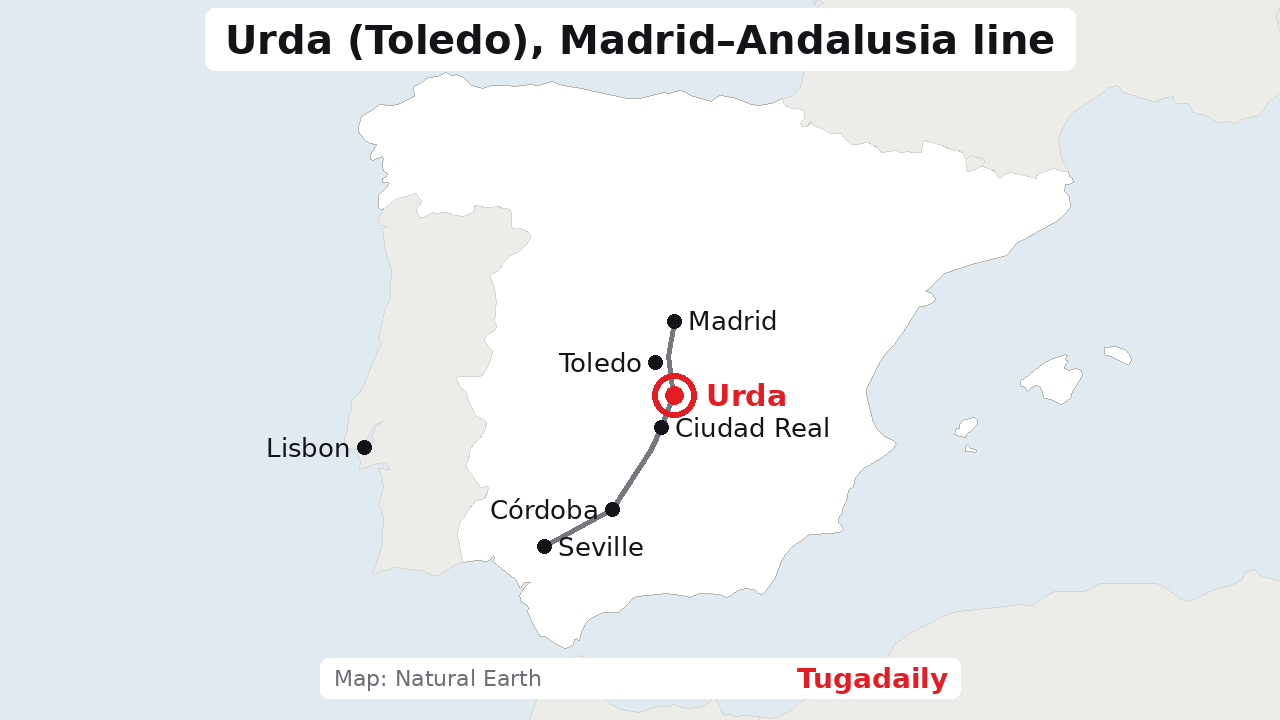
A Renfe AVE hit the back of a stopped Iryo train at 8:54 (7:54 in Lisbon) on the Madrid–Andalusia high-speed line near Urda. More than 540 people were on board, more than 80 are injured, and Spain's government points to human error during a signalling failure.
At least 30 people were killed on Wednesday morning when two high-speed trains collided near Urda, in Toledo province in central Spain. Castilla-La Mancha’s regional president, Emiliano García-Page, gave the count early in the afternoon: 24 dead on the Renfe AVE and six on the Iryo train. He expects the number to rise, as some of the injured are in the most serious triage category.
More than 80 people are hurt, 50 of them seriously. Some figures circulating already put the death toll near 50, but none had been confirmed by the regional government by early afternoon.
How it happened
The collision came at 8:54 Spanish time (7:54 in Lisbon), at kilometre 118 of the Madrid–Andalusia line between Mora and Urda, according to the network operator, Adif. A Renfe AVE ran into the back of an Iryo train that was standing on the track. Two of the Iryo’s rear carriages left the rails and went down an embankment.
The two trains were carrying more than 540 people between them. There were 397 on the AVE and 147 on the Iryo, a baby among them, according to the Castilla-La Mancha government’s spokesperson, Esther Padilla.
What caused it is not yet established
Spanish government sources point to a human error at the Atocha control centre while the line’s main signalling system was down. That is a preliminary line, not a finding. A court in Orgaz has taken the case, and Transport Minister Óscar Puente is due to speak at 14:00 Spanish time.
High-speed services between Madrid and Andalusia are suspended until further notice, and Adif and the train companies are asking anyone booked for today to stay away from stations. Renfe has opened a helpline for families on 900 10 10 20. Castilla-La Mancha has activated its regional emergency plan, called in the army’s emergency unit and asked blood donors to go to hospitals in Toledo and Ciudad Real.
Portugal’s response
Portugal’s foreign minister, Paulo Rangel, passed the government’s condolences to his Spanish counterpart, José Manuel Albares. Spain has not yet released the nationalities of the victims, and Portuguese consular staff are in touch with the Spanish authorities.
It is the second major disaster on Spain’s high-speed network this year, after Adamuz, in Córdoba, on 18 January. Several parties have suspended election campaigning and the government has cleared its schedule. Line status updates come from Adif, Spain’s rail network operator, and Renfe is running the families’ helpline.
Map: Tugadaily, outlines from Natural Earth (public domain)