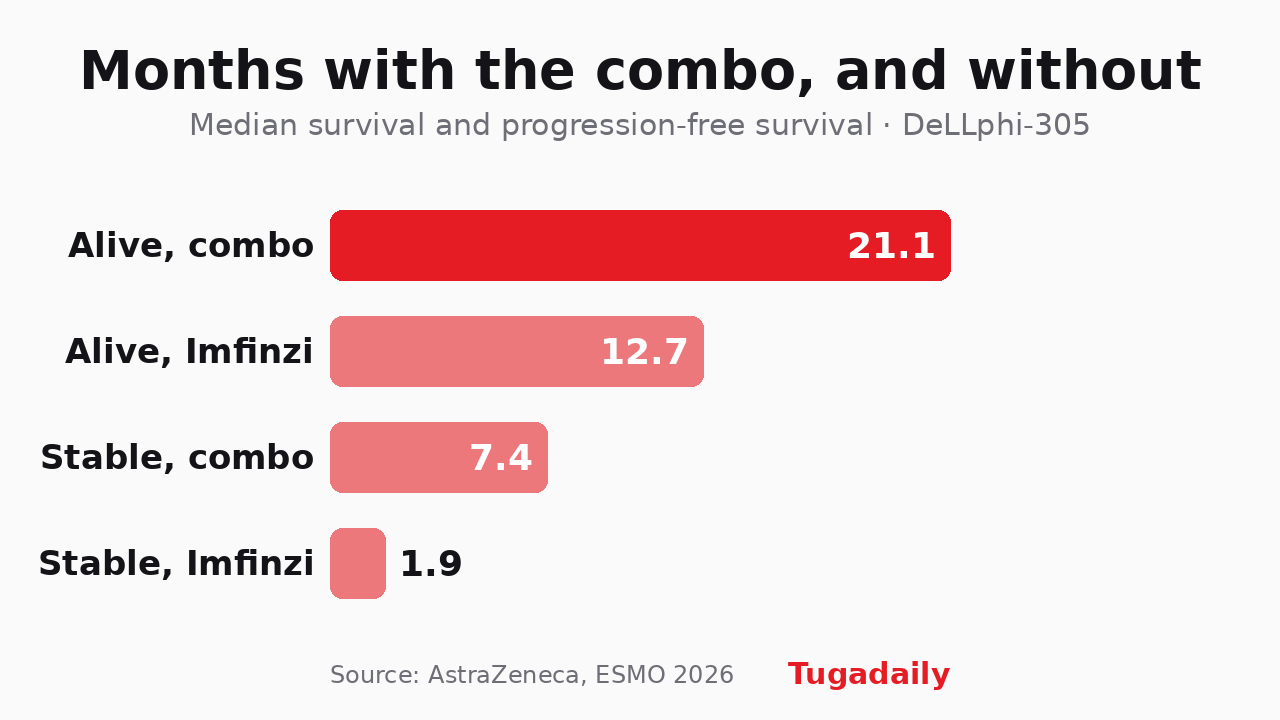
A two-drug maintenance took median survival in small cell lung cancer from 12.7 months to 21.1
In the Phase 3 DeLLphi-305 trial, presented at ESMO 2026 in Madrid, adding Amgen's tarlatamab (Imdelltra) to AstraZeneca's durvalumab (Imfinzi) as maintenance in extensive-stage small cell lung cancer cut the risk of death by 58%.
Small cell lung cancer is one of the hardest cancers there is. Once it has spread, median survival on today’s treatment is about a year, and only around 3.6% of patients reach five years. So the figure presented on Saturday at the European oncology congress, ESMO, in Madrid landed hard: adding a second drug to maintenance therapy cut the risk of death by 58%.
What was tested
The trial is called DeLLphi-305, a Phase 3 study of 563 patients with extensive-stage disease whose cancer had not progressed after first-line chemotherapy with durvalumab (AstraZeneca’s Imfinzi). Half stayed on durvalumab alone. The other half also got tarlatamab (Amgen’s Imdelltra), an antibody that grabs a tumour cell and an immune T cell at the same time, so the second can attack the first.
The results, published the same day in the New England Journal of Medicine:
- median survival of 21.1 months on the combination, against 12.7 on durvalumab alone;
- 79% of patients alive after a year, against 53%;
- 7.4 months before the disease progressed, against 1.9;
- tumours shrank in 26% of patients on the pair, against 4%.
The full figures are in AstraZeneca’s DeLLphi-305 release; the company part-funded the study.
The cost in side effects
More treatment meant more serious treatment-related side effects (grade 3 or 4): 20.9% of patients on the combination against 10.8% on durvalumab alone. No deaths were attributed to treatment. The first two doses of tarlatamab need monitoring in a healthcare setting, which in Europe can run to six to eight hours.
What happens next
Tarlatamab is already approved in the United States as a second-line treatment for this cancer. The maintenance combination is not approved anywhere yet, and Amgen has said it will take the data to regulators. There is no European timetable so far.
Lung cancer is the world’s leading cause of cancer death, and small cell disease makes up about 15% of cases. In Portugal, diagnosis has been moving too: Lisbon’s IPO carried out the country’s first robotic bronchoscopy this summer, a technique for reaching small nodules deep in the lung.
Chart: Tugadaily, data from AstraZeneca (ESMO 2026)