

Thunderstorms put 14 Portuguese districts under a yellow warning (with hail and 90km/h gusts)
Heavy showers and thunder across most of the mainland until the end of Sunday, with up to 20 millimetres of rain in a single hour and southerly winds strengthening along the west coast.
Fourteen of mainland Portugal’s eighteen districts spent Sunday under a yellow weather warning, and the reason is the one nobody plans for in late August: heavy showers and thunderstorms.
The districts are Aveiro, Braga, Bragança, Castelo Branco, Coimbra, Guarda, Leiria, Lisbon, Porto, Santarém, Setúbal, Viana do Castelo, Vila Real and Viseu. The warning from the Portuguese Institute for Sea and Atmosphere runs to the end of the day, and unusually for a weather notice it comes with hard numbers attached.
Rain may accumulate at 10 to 20 millimetres in a single hour. Any hail should measure under two centimetres across. Gusts around the storm cells are forecast between 70 and 90 kilometres an hour. In November this would be an ordinary Sunday. In the middle of the holiday month, with much of the country on a beach or on a motorway, it is not.
What the forecast actually says
Rain is expected mainly on the west coast and from mid-morning onwards, possibly persistent, sometimes heavy, and accompanied by thunder. The wind turns southerly and picks up along the coast and over high ground, which matters if your plans involve a boat or a hillside.
Yellow is the lowest of the three levels in the Portuguese system. It flags a risk to activities that depend on the weather rather than a general emergency, and the live district-by-district list sits on the IPMA warnings page.
The four districts left out
Beja, Évora, Faro and Portalegre are absent from the list. The Alentejo and the Algarve stay clear of the instability arriving off the Atlantic, which is why Sunday looks like two different countries depending on where you woke up.
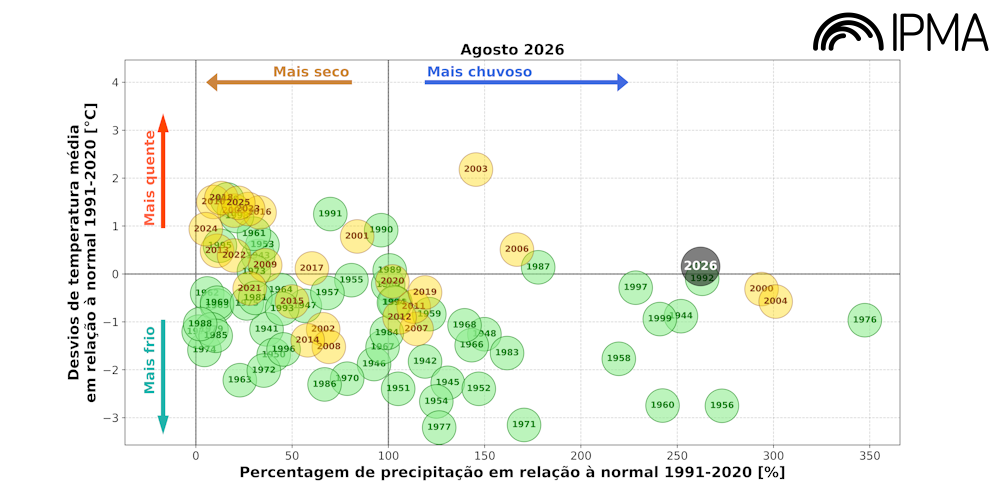
The rain also lands on a country that has just come through its driest July of the century, with meteorological drought covering the whole mainland. One afternoon of downpours does not undo a deficit built over months, and water falling fast on baked ground tends to run off rather than soak in. What does change, for a few hours at least, is the fire risk. In August that counts for a lot.
Photo: Walterpeitz / Wikimedia Commons (CC BY-SA 4.0)