
Portugal has just raised its no-tender ceiling for public works fivefold. The new rules start on 1 October
Decree-Law 177/2026, published on Friday, is the seventeenth amendment to the Public Contracts Code. It lifts four thresholds at once, the largest of them from 150,000 to a million euros.
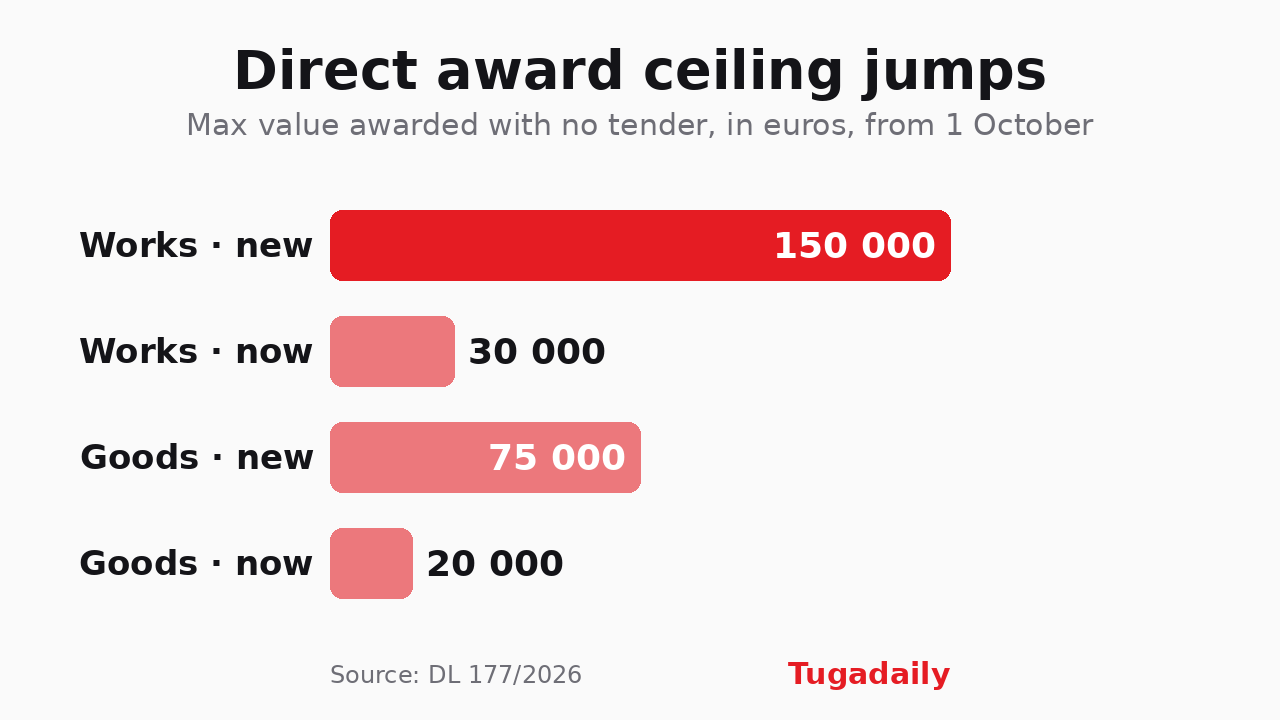
A town hall that wants a school roof rebuilt will soon be able to pick a firm, agree a price and sign, with no competition at any point, as long as the job comes in under 150,000 euros. The current cut-off is 30,000. That is five times more room.
The rule appeared in the official gazette on Friday. Decree-Law 177/2026 is the seventeenth amendment to the Public Contracts Code since 2008, and it applies from 1 October, leaving buyers just under four weeks to get ready.
Four ceilings, all going up
Two light-touch procedures sit below the open tender. In the first, the buyer invites a single company and negotiates. In the second, it must invite at least three.
For construction work, the single-invite ceiling rises from 30,000 to 150,000 euros, and the three-invite one goes from 150,000 to a million. For goods and services, the figures move from 20,000 to 75,000 and from 75,000 to 130,000. Four ceilings, all lifted on the same day, and the biggest proportional jump is that million: close to seven times the old limit.
The government blames slow procedures, paperwork and values that have sat unchanged since 2008 while construction costs did not. The stated goal is to get public money spent faster, a complaint that runs through Portugal’s use of EU funds and that surfaced when several charities in the Braga district came close to losing recovery-plan funding over procedural delays.
What else is in it
The decree does more than move numbers. Grounds for excluding a bid, previously scattered through the Code, are now gathered in a single article. Arbitration becomes entirely voluntary, and contracting parties get technical conciliation panels for disputes. Buyers also gain room to shape the procedure themselves in tenders below the European thresholds, where that makes things simpler or quicker.
There is a new reason to award nothing at all, too: the absence of satisfactory bids. A buyer that dislikes what arrives can close the process without choosing anyone.
The part worth watching
Fewer open tenders means fewer companies find out that public money is on the table, and that is where lawyers have been raising flags since the April draft. A 149,000-euro contract handed straight to one firm is perfectly legal. It is also impossible to compare with anything.
Oversight has not gone anywhere. The Court of Auditors still clears contracts above its own limits, and the European Public Prosecutor is still looking at Portuguese procurement, as the case of the building work the judicial police awarded to a firm in Barcelos showed. What changes is how many contracts will now begin life with no rival in sight.
Chart: Tugadaily, with data from Decree-Law 177/2026