Brussels puts Portugal on none of its migration pressure lists, then singles it out on returns
The European Commission's 2026 asylum and migration report (COM(2026) 835, 6 November) names Greece, Cyprus, Italy and Spain as under pressure. Portugal is in no category, yet ranks second in the EU for Schengen return-alert hits and third for return orders, relative to GDP and population.
Portugal is not under migratory pressure, not at risk of it and not facing a “significant migratory situation”. That is the verdict of the annual asylum and migration report the European Commission published on 6 November, the first since the EU’s Pact on Migration and Asylum took effect on 12 June.
Then the report does something it does not have to. It names five countries that fall into no category but face “specific situations” worth flagging. Portugal comes first.
Why does the Commission single out Portugal in its migration report?
Return alerts. Relative to GDP and population combined, Portugal had the second-highest number of hits on Schengen return alerts as a country of destination. A return alert is the entry, visible to every police force in the Schengen area, recording that someone has been ordered to leave the EU. A hit is what happens when that person turns up again at a check.
The other four on the list are Malta, Slovakia, Sweden and Hungary, each for a different reason.
How many return orders does Portugal issue?
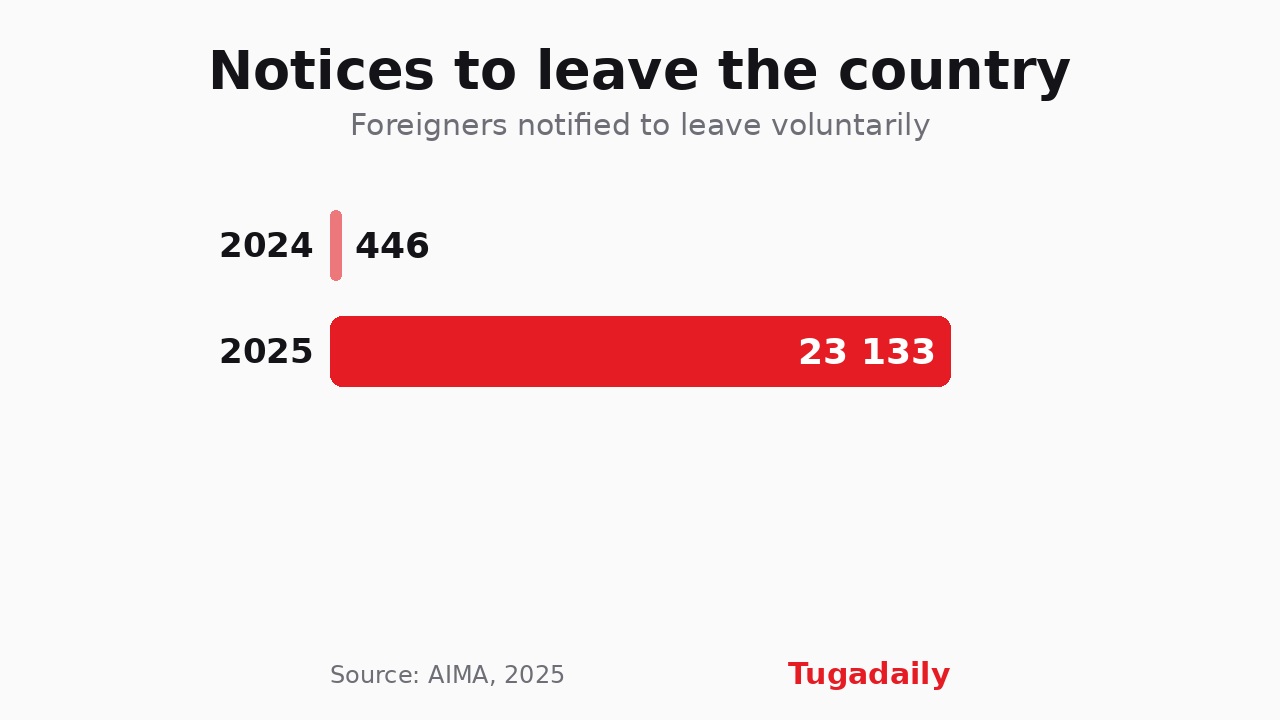
The report gives the ranking rather than the raw figure. Relative to GDP and population, Cyprus issues by far the most return orders, followed by Croatia and then Portugal. Across the EU, 463,000 orders were issued between July 2025 and June 2026 (down 5%), and 142,000 people were actually returned (up 11%).
A footnote says who they went to. Portugal’s orders were mostly issued to nationals of Brazil, India and Angola, a very different mix from France (Algeria, Tunisia, Morocco) or Germany (Türkiye, Syria, Afghanistan). It sits alongside the new European return order that one country can enforce on another’s behalf.
How many Ukrainians with temporary protection live in Portugal?
There were 68,310 in June 2026, according to the Commission’s table. By our count that is about 1.55% of the 4.4 million temporary-protection holders across the EU, where Poland alone hosts 961,000.
Two more Portugal details sit in the reception chapter. Temporary-protection holders make up more than half of everyone housed in Portugal’s asylum reception system, as in Finland, Sweden, Austria and Slovenia. And Portugal is one of the countries that added accommodation places, along with Croatia and Denmark.
What does Portugal still have to do under the Pact?
It has told Brussels it fully transposed the new reception rules. What it has not yet done is formally designate the national body that monitors fundamental rights during screening and the asylum border procedure. Belgium, Hungary, Italy, Lithuania, Malta, the Netherlands and Sweden are in the same position, and the report says work is ongoing.
Which EU countries are under migratory pressure?
Greece and Cyprus, on arrivals and applications combined. Italy, because of disembarkations after search-and-rescue operations. And Spain, which asked the Commission to count the mass crossing into Ceuta on 30 and 31 July, after the reference period closed. Those four can draw on the solidarity pool, through which other member states help with relocations, money or equipment.
EU-wide, the trend is still downward: irregular crossings at the external borders fell 32% and asylum applications 16%, to 730,800. Staying off the lists does not take Portugal out of the conversation. It only keeps it out of the queue for help.
Image: Carlos Costa / European Union, 2025 / Wikimedia Commons (CC BY 4.0)