Before you pay anyone for an AIMA appointment, check who sent the email
A group of Brazilians says it paid an alleged lawyer for AIMA appointments that never existed, and at least two have gone home. AIMA only sends bookings from @aima.gov.pt, or @sef.pt on systems still being migrated. How to check before paying, and where to report it.
A group of Brazilians says it paid an alleged lawyer around 30,000 euros in total for appointments at AIMA, Portugal’s immigration agency, that never existed. On a list the group shared, 21 people account for almost 18,500 euros in fees, and at least two of them have given up and gone back to Brazil.
Anyone who has dealt with AIMA will recognise the pattern. People arrive on a tourist visa, can’t get a slot on their own, and end up paying a middleman who promises a shortcut. Some in this group were told they had a biometrics appointment booked at an association in Sines. They didn’t. The case has been reported to the police.
Money paid to a fake appointment is rarely coming back. What you can do is check a booking before you hand anything over.
Start with the sender
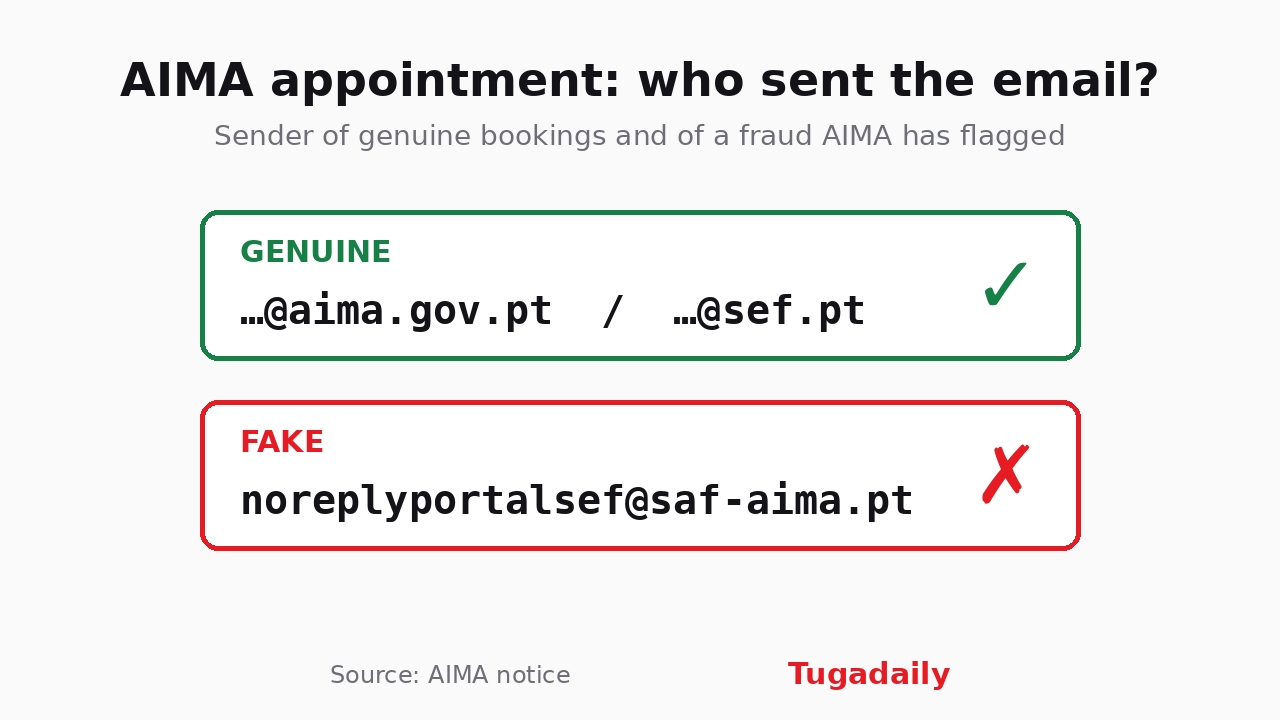
AIMA itself says, in a notice on fraudulent emails, that genuine appointment emails come from the aima.gov.pt domain. A few systems still being restructured may send from sef.pt, inherited from the old border service, SEF. Anything else should make you suspicious.
The agency named one fake: noreplyportalsef@saf-aima.pt is not AIMA, even though it has both “aima” and “sef” in it. That is exactly the kind of address that slips past on a phone screen.
If something like that lands in your inbox, the official advice is short. Don’t click the links, block the sender, mark it as spam and delete it.
Check who is charging you
Representing someone before a public body for a fee is, as a rule, reserved for lawyers and solicitadores under Law 49/2004. Doing it without being registered is a crime in Portugal, known as procuradoria ilícita.
Checking takes a minute. The Portuguese Bar Association runs a public search of registered lawyers where you can look someone up by name. If the person asking for your money isn’t there, you have your answer.
Be wary, too, of cash payments, transfers to personal accounts and “slots” nobody else seems able to get.
Where to report it
AIMA points to two routes: an online cybercrime complaint through the forms run by the Polícia Judiciária and the Public Prosecutor’s Office, or in person at a PSP police station or a GNR post. Keep the messages, the payment receipts and the name and contact details of whoever took the money.
This is not the first time we have reported on immigrants let down by the person meant to help them. In July, golden visa applicants lost 1.2 million euros to their own lawyer. For changes to AIMA’s deadlines and procedures, our AIMA tracker is kept up to date.
Graphic: Tugadaily, from AIMA's notice