Portugal finally signs off the rulebook for its new citizenship law, 74 days late
On 29 October the Council of Ministers approved the decree-law regulating Organic Law 1/2026: the language, culture, history and civics tests, the means-of-subsistence requirement, the declaration of adherence to the rule of law and biometric data collection. It still needs the President's signature and publication.
Portugal’s government approved the decree-law regulating the new Nationality Law on Thursday 29 October. It is the instruction manual for the law that came into force in May, and it arrives 74 days after the deadline the law itself set.
Organic Law 1/2026 was published on 18 May and gave the government 90 days to update the Portuguese Nationality Regulation, which dates from 2006. That window closed on 16 August. We checked in August and found nothing had been published, and registry offices have since been applying the old rules wherever they did not clash with the new law.
What the regulation settles
According to the communiqué, the decree sets out how the tests of Portuguese language, culture, history and institutions are to be held. It also defines how applicants prove they can support themselves, how the declaration of adherence to the principles of the democratic rule of law is made, and how biometric data is collected.
Those were precisely the missing pieces. The May law created the requirements, but without a regulation there was no way to meet them at the counter. The government is also promising more digital processing and automatic document exchange between departments to speed decisions up. Presidency minister António Leitão Amaro said citizenship now demands clearer proof of a real connection to the country.
Residence periods, and a wording slip worth noticing
The government’s note sums up the residence rule as seven years for nationals of the PALOP (Portuguese-speaking African countries) and EU citizens, and ten years for everyone else. Article 6 of the law says something broader. The seven years apply to nationals of “countries whose official language is Portuguese”, which takes in Brazil and Timor-Leste, neither of them PALOP.
For Portugal’s largest foreign community, that is not a footnote. A regulating decree cannot override an organic law, so the law’s wording is what counts. It is still worth reading the decree when it is published. The same law presumes that nationals of Portuguese-speaking countries know the language, unless it is plainly obvious they do not.
For children born in Portugal to foreign parents, citizenship at birth now depends on one parent having at least five years of legal residence when the child is born.
When it starts to apply
Not yet. The decree goes to the President for promulgation and only takes effect once it is published in the Diário da República. Until then, the 2006 regulation still governs.
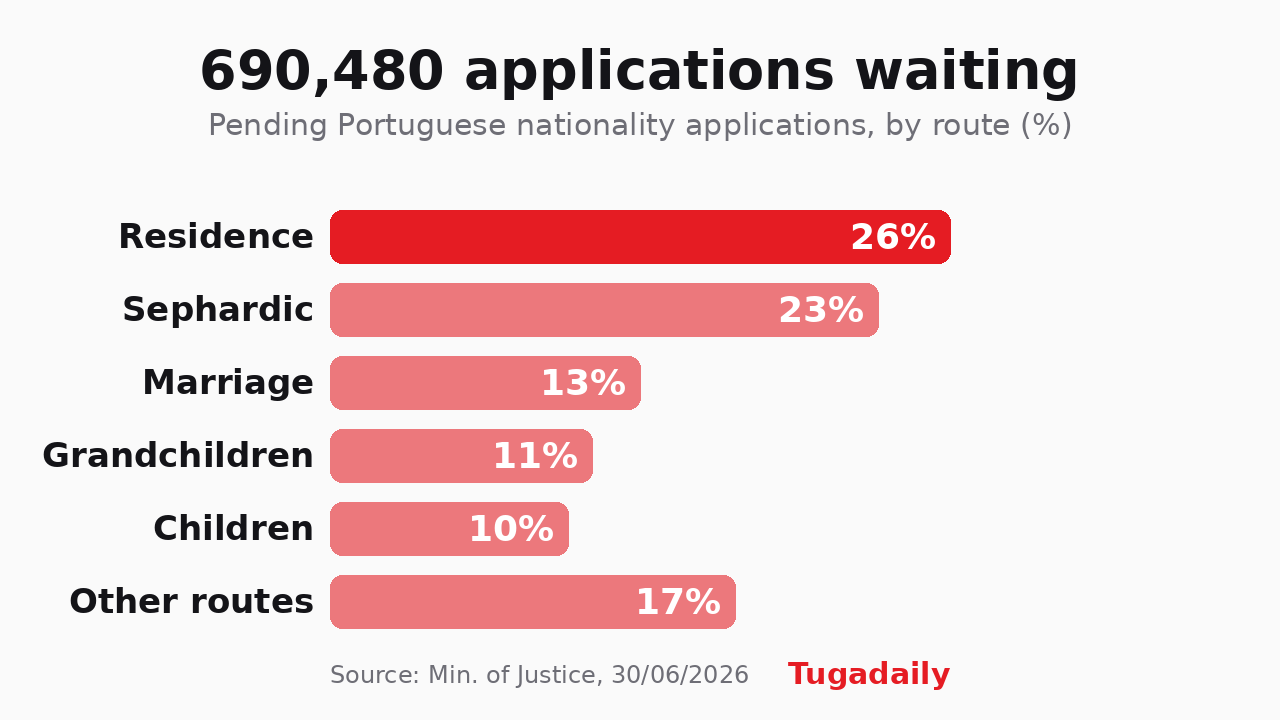
None of this touches the queue already in place. The IRN registry agency had 690,480 nationality applications awaiting a decision on 30 June, and the old rule of thumb holds: the date your application went in decides whether the old law or the new one applies.
Illustration: Tugadaily