Around 180,000 immigrants are waiting for Portuguese citizenship. Portugal naturalised 12,829 last year
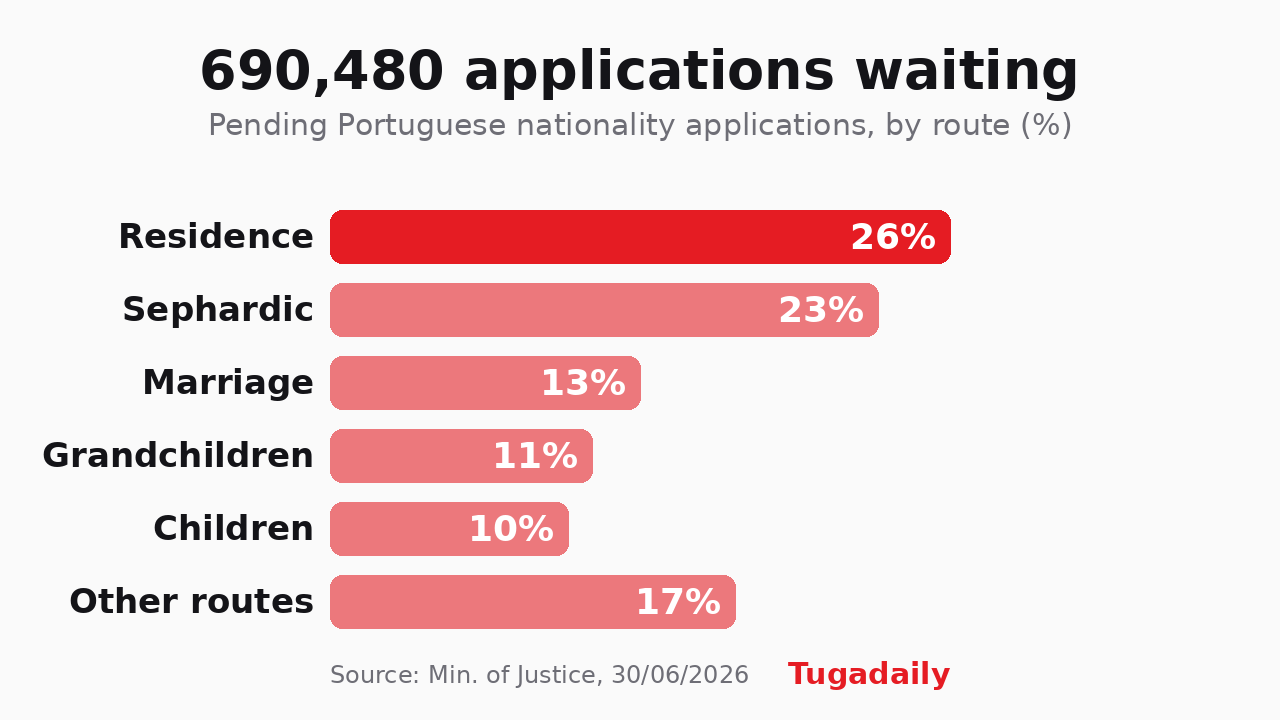
Portugal's registry office had 690,480 nationality applications pending on 30 June, up 38% in a year, and 26% come from people who live here and applied on residence grounds. At 2025's pace, that queue alone is roughly 14 years long.
Portugal’s registry office, the IRN, was sitting on 690,480 undecided nationality applications on 30 June. The figures come from the Ministry of Justice and show a 38% rise on the same point in 2025, when the pile stood at roughly half a million.
That headline number blurs who is actually in the queue. Only 26% of the files belong to immigrants living in Portugal who applied on the strength of their years of legal residence. Most of the rest are descendants of Sephardic Jews (about 23%), spouses and partners of Portuguese citizens (13%), grandchildren of Portuguese nationals born abroad (11%) and children (10%).
Our arithmetic
Take 26% of 690,480 and you get close to 180,000 applications from people who already work here, pay tax here and are waiting for a passport. Set that against how fast Portugal actually naturalises them. According to INE, 12,829 foreign residents acquired Portuguese nationality in 2025, down 38% from 20,624 in 2024.
If 2025’s pace held, clearing the residents’ share alone would take about 14 years. That is a rough sum, on purpose. Staffing changes the pace, the two statistics don’t measure exactly the same group, and not every application will be approved. It still says more about the scale than 690,000 does on its own.
Why residents wait longest
The ministry puts part of the drop in naturalisations down to priorities. The IRN is clearing attribution requests first, above all those for minors who are children of Portuguese citizens and apply through consulates or online, because in those cases nationality is a right from birth. Acquisition by residence comes after.
Extra staff are only just arriving. The registry took on 47 new conservadores in August, its first in over twenty years, but a registrar in their first month does not clear thousands of files.
What about the new rules?
The data runs to 30 June, so it covers just six weeks of the new law. Organic Law 1/2026, in force since 19 May, raised the minimum legal residence to seven years for CPLP and EU citizens and ten years for everyone else, up from five across the board.
If you have an application pending, the practical advice is easy to say and harder to live with. Keep your proof of submission, keep your AIMA residence permit current, and don’t plan around a quick decision. The regulations that should flesh out the law were also due by 16 August and never appeared.
Chart: Tugadaily · Ministry of Justice data (30/06/2026)