
Eight dead in Chiba after Japan's heaviest recorded day of rain there since 1966
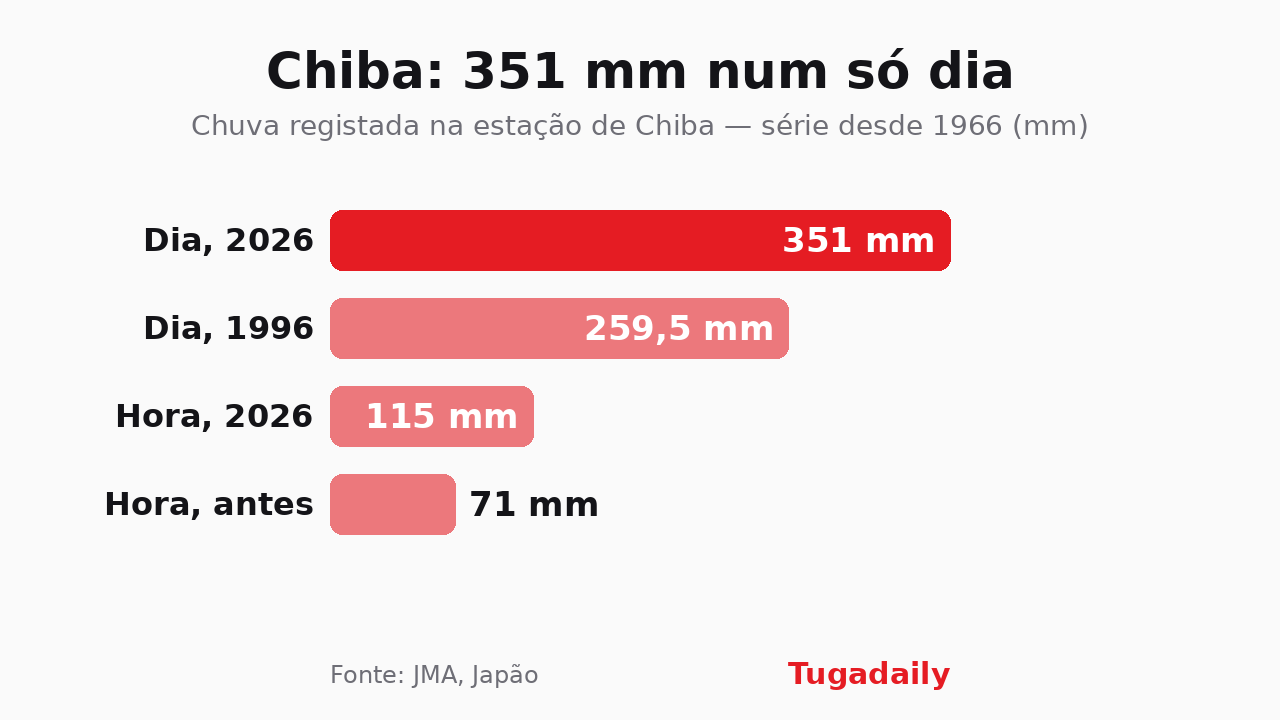
The Chiba weather station logged 351 mm on 13 August, the largest daily total in a series going back to 1966, and 115 mm in a single hour. Six thousand people spent the night inside Narita airport.
Chiba sits east of Tokyo, it holds one of the Japanese capital’s two big international airports, and it is in theory one of the best-prepared places on earth for heavy rain. On Thursday that was not enough.
The Japan Meteorological Agency logged 351 millimetres of rain at the Chiba station on 13 August. That is the largest daily total in a series beginning in 1966, and it clears the previous record of 259.5 millimetres, set in 1996, by a wide margin. In one sixty-minute window 115 millimetres fell, against a previous hourly maximum of 71. The agency gave the episode its own official name, something it does only when it treats an event as exceptional.
Eight deaths, shelters open in 39 municipalities
Japan’s Fire and Disaster Management Agency, in the report it published on 14 August, counts eight dead: three in Chiba City, two in Sakura, and one each in Ichikawa, Kashiwa and Yachiyo. Several involved flooded roads and vehicles caught by fast-rising water.
At six on Friday morning, 7,359 people were in 359 shelters across 39 municipalities. Level 4 evacuation orders covered more than 36,000 people in three municipalities.
Six thousand people sleeping at Narita
The detail that travelled furthest was a different one. At a coordination meeting at 22:30 on Thursday, around six thousand people were still inside Narita International Airport with no way out, and were given water, food and sleeping bags there. Elsewhere in the prefecture, 17 temporary facilities were housing nearly four thousand people who could not get home.
The main rail lines came back through Friday, but the Narita Express and several regional lines stayed suspended all day. Around 19,600 premises were still without power in the afternoon, with a substation submerged in Chiba, and gas was cut to close to 13,000 households.
The ground is saturated, and prefectural authorities warned that even modest further rain could set off landslides. Europe has been living the same equation from the opposite end: here, July was the driest of the century across Portugal. In both cases what changed is not that there is too much water or too little — it is how fast it arrives.
Chart: Tugadaily · data from the Japan Meteorological Agency