Hoax bomb threats hit six European flights, including a Ryanair jet out of Lisbon
A Lisbon–Rome Ryanair flight was searched at Fiumicino after an anonymous email. Planes made emergency landings in Murcia and Warsaw and one airport shut for two hours. No explosives were found anywhere.
At least six passenger planes were the target of bomb threats across Europe on Tuesday morning, 3 November. One was a Ryanair flight that had taken off from Lisbon for Rome. Every aircraft landed safely, and bomb-disposal teams found nothing on any of them.
The Lisbon flight
The plane from Lisbon touched down at Fiumicino at around 9:40 Rome time (8:40 in Lisbon), with a second Ryanair jet from Dublin landing about an hour later. Investigators quoted in the Italian press said Aeroporti di Roma, which runs Fiumicino, had received an anonymous email claiming both were carrying bombs.
What followed was routine, if slow. Both aircraft were moved aside, passengers and bags were screened again and explosives technicians went through the cabins. The alert was lifted shortly after noon. We found no public statement from Ryanair or from Portuguese authorities about the flight that left Lisbon.
Murcia, Warsaw and Sofia
Spain saw the biggest disruption. A Ryanair flight from Manchester made an emergency landing at Región de Murcia airport with 114 passengers and seven crew, who were evacuated onto the apron. The airport closed for more than two hours and reopened at 13:00, and an inbound flight from Gran Canaria had to divert to Alicante.
In Poland, a LOT plane from London Heathrow with 181 people on board was sent to Modlin, about 36 km outside Warsaw, and the airport halted operations until around midday. An SAS flight from Copenhagen was also named in a threat but landed as planned at Warsaw Chopin. In Sofia, a plane arriving from Israel was searched by counter-terrorism units after another email, according to Bulgarian interior ministry secretary general Lyubomir Nikolov.
The day before, a Wizz Air flight from London to Sofia had already been diverted to Budapest under a Hungarian fighter escort after a similar warning.
Who sent them
Nobody knows yet. Authorities have not identified the sender or confirmed the threats are connected, though the timing and the method point that way. They arrive in the same week as a cyberattack that knocked out supermarket fridges in several European countries, seven Portuguese stores among them. There is no official suggestion the two are linked.
If you are flying this week, the practical fallout is small: there were no mass cancellations, and every affected airport was back to normal by early afternoon.
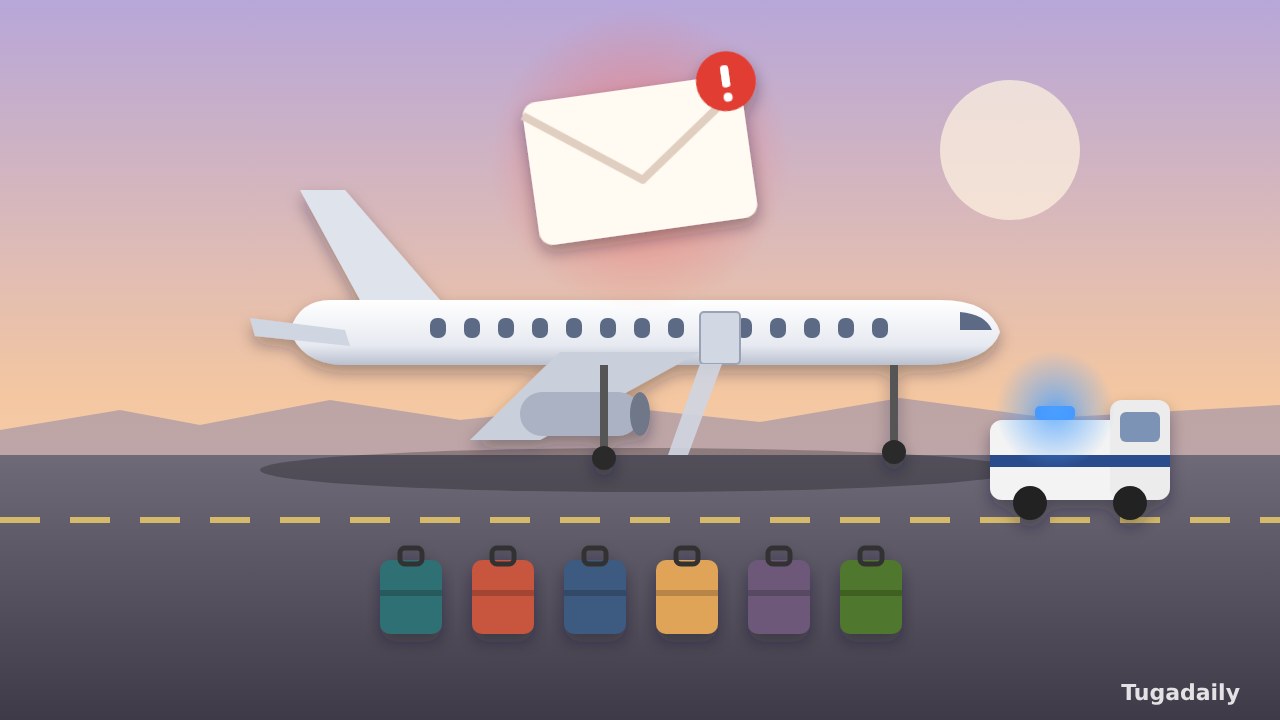
Illustration: Tugadaily