
Portugal sets no upper age limit for driving. A petition wants one, at 75
The text filed with the Assembly of the Republic asks for licences to expire automatically at 75. Today the law works the other way round, through renewal deadlines and individual fitness assessments.
The question has been going round neighbourhood groups and comment threads since the start of the month, and the legal answer catches most people out. Portugal has no maximum age for driving a car.
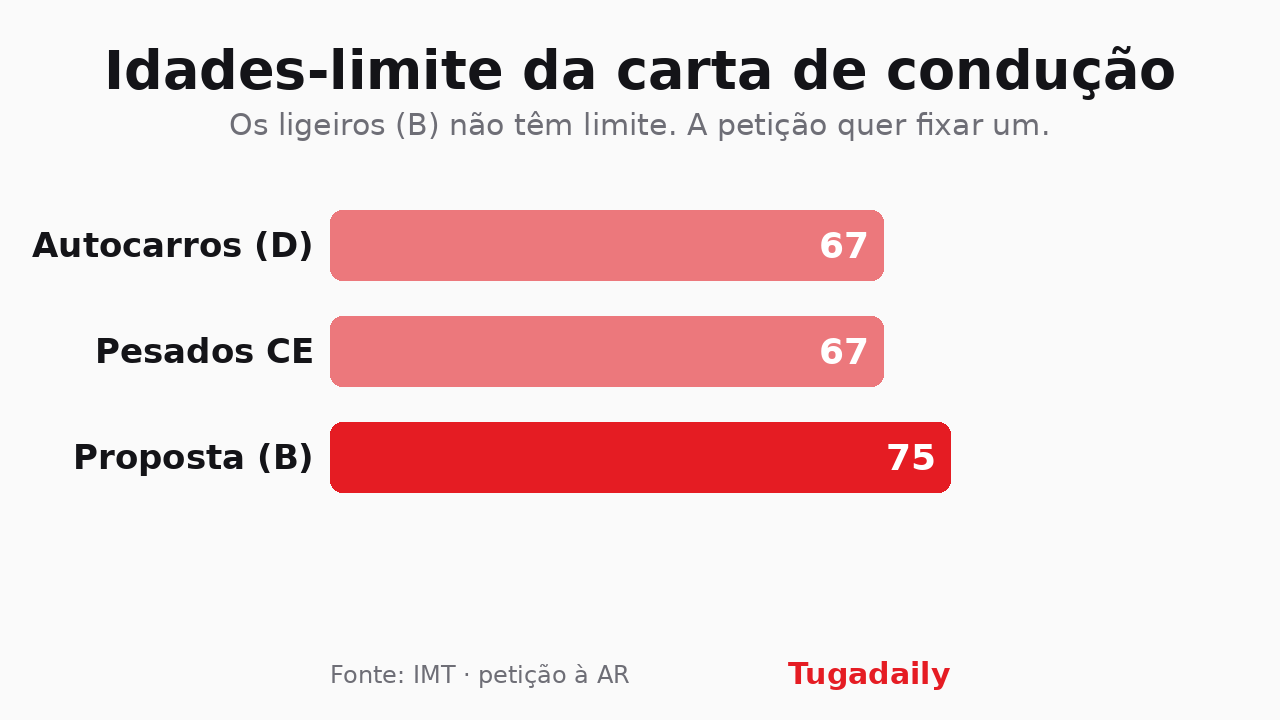
What it now has is a petition asking for one. Filed with the Assembly of the Republic and created on 1 April, it proposes that a driving licence should expire automatically at 75.
The petitioner, Nélson Manuel de Oliveira Ferreira, argues that cognitive, visual and motor decline past that age is inevitable, and that slower reactions and weaker perception make driving unpredictable. The text concedes the measure would bite hard on daily life and calls for alternative mobility options for older people, without setting out what those would be.
What the law says today
For category B and the rest of group 1, there is no general maximum age, provided the driver meets renewal deadlines and keeps the fitness the law requires. Assessment is individual, done at renewal, not triggered by a birthday.
Age does bite on the heavy categories. Portugal’s driving licence regulations state that D1, D1E, D and DE licences stop being valid at 67 and cannot be renewed after that. In category CE, past 67 the licence is restricted to vehicles up to 20 tonnes.
A petition is not a law
Worth separating the two, because this is where the argument usually derails. A public petition is a civic participation tool rather than a bill, and it only gains parliamentary traction by clearing signature thresholds: above a thousand it is examined in committee, above 7,500 it goes to a plenary debate.
The counter-argument is already loud. A fixed cut-off treats unlike cases alike, critics say, and plenty of 55-year-olds drive worse than plenty of 80-year-olds. Most of Europe has moved the other way, towards individual medical assessment at shortening intervals rather than a flat ban.
For anyone living outside the big centres the maths is blunter still. Without a car, and without serious public transport, a hospital appointment in the district capital stops being a mobility question and becomes an isolation one. It is a debate Portugal has not properly had, and it now runs alongside other changes to how the country handles licences and cross-river commuting, including the two new Tagus crossings promised for the next decade.
Chart: Tugadaily · data from Portugal's driving licence regulations and the petition