
1,777 pregnant workers and new parents in Portugal were told their contracts would not be renewed
Employers filed 1,777 non-renewal notices with the equality commission CITE in 2025, down from 1,894 in 2024. Non-renewal outnumbers formal dismissal roughly fifteen to one.
Portugal’s equality commission for work and employment, CITE, received 1,777 notices during 2025 from employers who would not be renewing fixed-term contracts held by pregnant women, women who had recently given birth, breastfeeding mothers or workers on parental leave. The figure was published on Tuesday by the women’s equality commission of the CGTP-IN trade union confederation, timed to National Natality Day.
The 2024 total was 1,894. So the number has fallen, but not by much.
CITE is careful about one point, and it deserves repeating: these are mandatory filings, and they do not by themselves show that every case was discriminatory. Fixed-term contracts end for plenty of legitimate reasons.
The pattern is in the mechanism
The revealing number is not any single year’s total. It is how these jobs end.
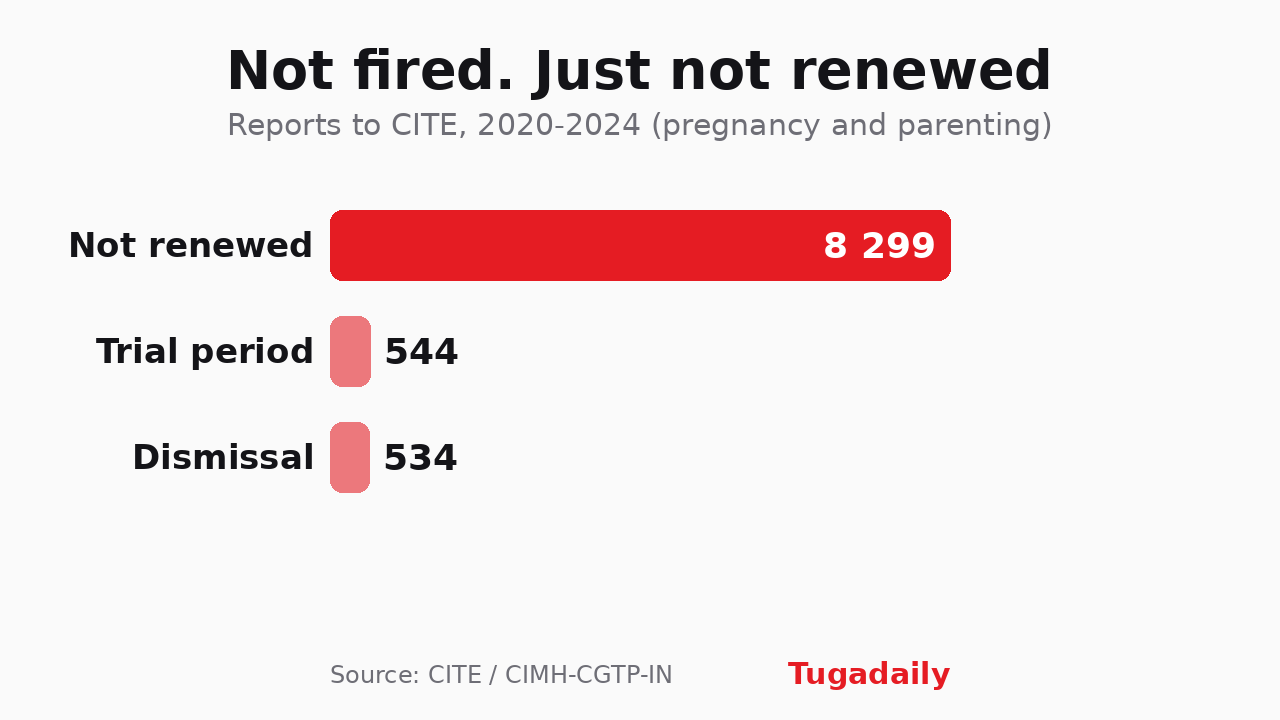
Between 2020 and 2024 there were 8,299 non-renewals of fixed-term contracts involving pregnant, postpartum or breastfeeding workers and people on parental leave. Over the same five years there were 544 terminations during a trial period and 534 dismissals. That works out at roughly fifteen quietly expired contracts for every dismissal on the record.
The distinction matters in practice. Dismissing a pregnant, postpartum or breastfeeding worker in Portugal requires a prior opinion from CITE and is hard to defend. Letting a fixed-term contract run out requires none of that, only the notification. The law protects permanent staff well and everyone else considerably less.
Why this argument, and why now
The publication date was not chosen at random. Portugal has spent years debating how to arrest its falling birth rate, and the INE’s vital statistics keep showing fewer births than replacement would need.
The union case is blunt. It is hard to ask people to start families when the years for doing so line up exactly with their most precarious years at work. Employers’ groups counter that fixed-term contracts exist to absorb uncertainty, and that a filing count measures notifications rather than intent.
The raw data and the annual reports sit on CITE’s own statistics page, which is where the argument ought to start. It is also an argument about where the state chooses to put its money, in a year that has already produced supplements designed to hold staff in some regions and not others.
Chart: Tugadaily · Data: CITE / CIMH-CGTP-IN