PT
Two ICE officers, seen from behind in jackets marked Police ICE, escort a man to a chartered removal flight at night
Immigration 14 November 2026

ICE deported 483,200 people in fiscal 2026, a record for the agency and still short of half the White House target

The Department of Homeland Security said on 11 November that ICE removed 483,200 people between October 2025 and September 2026, up 9% on the year before and 78% on 2024, with more than 491,000 arrests. The White House had talked of a million a year.

US Immigration and Customs Enforcement deported 483,200 people in fiscal year 2026, which ran from October 2025 to September 2026. It is the highest total in the agency’s 23-year history, according to the Department of Homeland Security’s year-end release, announced on Wednesday.

Arrests set a record too, at more than 491,000. August was the busiest month ever at 50,925, and September came in above 48,000.

How many people did the US deport in 2025 and 2024?

In fiscal 2025 the figure was 442,640, and in 2024, Joe Biden’s last full year, 271,480. By our count that is a 9% jump in a year and 78% in two.

Put another way, ICE removed around 1,324 people a day on average.

Did ICE hit the one-million target?

No, and not by a little. The White House had talked of a million deportations a year. The record is 48% of that, 516,800 short. Stephen Miller, widely described as the architect of the policy and named White House chief of staff after the midterms, now has a number that can be read either way.

What do the ICE figures leave out?

Quite a lot. DHS gave no breakdown of how many of those deported had criminal convictions. An independent group that studies the agency’s data, the Deportation Data Project, found that about a quarter of people deported in July had one. Steven Camarota of the Center for Immigration Studies, a think tank that favours lower immigration, said he could not tell how many cases were arrests inside the country and how many were people turned back at the border or at airports.

The politics have shifted too. Trump’s approval on immigration fell to 38% from 50% at the start of his term in a Reuters/Ipsos poll, and Democrats, who take the House majority in January, say they will investigate DHS.

How does that compare with Portugal?

It is a different scale entirely. Portugal’s police border unit carried out 221 forced returns and 1,732 voluntary ones in its first year, from August 2025 to July 2026, and the PSP already says 2026 could be the country’s record year for removals. On an average day, ICE removed close to six times as many people as the PSP forcibly returned in those eleven-odd months.

By Juliana Castilho

Image: U.S. Immigration and Customs Enforcement / Wikimedia Commons (public domain)

Jet bridges and the aircraft apron at the terminal of Lisbon's Humberto Delgado Airport
Immigration 15 November 2026

Portugal ordered 11,190 people to leave in three months. Eurostat counts 330 returns

In Eurostat's second-quarter 2026 data, only France ordered more non-EU citizens to leave than Portugal did. But for every 100 orders issued here, about 3 returns were recorded in the same quarter, against 36 across the EU. Brazilians and Angolans received almost half of Portugal's orders.

Between April and June 2026, Portugal ordered 11,190 people from outside the European Union to leave the country. Only France issued more (32,420). The figures come from Eurostat's quarterly table of orders to leave, which we went through country by country. The part nobody had put next to it yet: in the same quarter, Eurostat records 330 returns of foreigners who had been ordered out of Portugal.

Continue reading
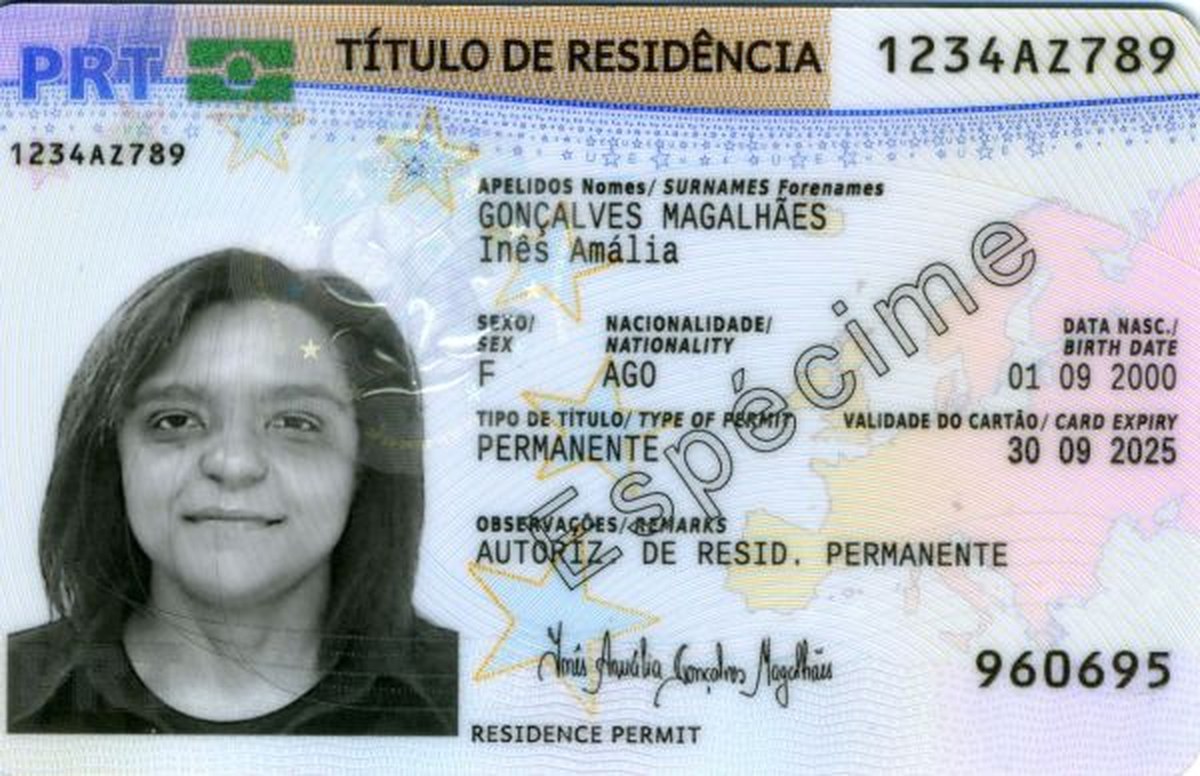
Official specimen of the Portuguese residence permit card, stamped Espécime over a fictional holder's details
Immigration 13 November 2026

The OECD says 319,000 people moved to Portugal in 2025. Many of them were already here

The OECD's annual migration report, published on 12 November, shows long-term immigration to Portugal up 130%. The figure includes changes of status, and in the same year AIMA issued more than 500,000 residence permits to clear its backlog.

Portugal took in 319,000 new long-term immigrants in 2025, 130% more than the year before. The figure comes from the Portugal country note in the OECD's International Migration Outlook 2026, published on Thursday, and you will see it quoted a lot. It is worth reading with the small print attached. Arrivals plus changes of status. The report says so in the same sentence: the 319,000 include "changes of status and free mobility". Someone who was already…

Continue reading
A Loja do Cidadão citizen shop, home to AIMA service desks
Immigration 12 November 2026

AIMA tracker: deadlines, backlog and updates

A running tracker of AIMA — case backlog, renewal deadlines, biometrics, golden visa and service changes. Updated whenever there is news.

If you are dealing with residence or nationality, this is the page to bookmark. Instead of one article per announcement, we gather the essentials of AIMA here: case backlog, renewal deadlines, biometrics, golden visa and service changes. For the citizenship rules, see the new nationality law. Official information is at AIMA. If you want to bring family to Portugal, you can now apply for family reunification directly with AIMA, even while your relatives…

Continue reading
A TAP long-haul aircraft parked on the apron at Lisbon airport with boarding stairs against it
Immigration 11 November 2026

More immigrants are asking IOM to help them leave Portugal. Only 325 have actually gone

Sign-ups for ARVoRe, the International Organization for Migration's assisted return programme, rose from an average of 55 a month in 2025 to 79 in 2026, up more than 40%. There have been 2,048 since it began, 86% of them Brazilian. Who qualifies, what it pays (up to €2,000 to restart) and how to apply.

More immigrants in Portugal are asking for help to go home. ARVoRe, the assisted voluntary return programme run by the International Organization for Migration (IOM), took an average of 79 sign-ups a month in 2026 (figures to September), against 55 a month in 2025, according to IOM numbers reported by the Lusa news agency. By our maths that is a 43.6% jump.

Continue reading
South facade of the Palacio de las Salesas Reales in Madrid, seat of Spain's Supreme Court
Immigration 9 November 2026

Spain's top court won't block 189,678 'grandchildren law' voters before 29 November

Spain's Supreme Court has refused, by majority, to extend a voting suspension to the 189,678 adult children of people who gained Spanish nationality under the 'grandchildren law'. They can vote in the 29 November general election. The 163,355 naturalised under a Justice Ministry instruction stay suspended, as they have been since 10 September.

The adult children of people who became Spanish under the so-called grandchildren law will be able to vote in Spain's general election on 29 November. The administrative chamber of Spain's Supreme Court on Monday refused, by majority, to extend to them the voting suspension already imposed on their parents, Euronews reported. That is 189,678 people, according to Spain's Foreign Ministry, who vote from abroad.

Continue reading
A worker in an orange suit and hard hat assembles the top of a yellow tower crane on a Lisbon building site, against a blue sky
Immigration 8 November 2026

Immigrants in Portugal can train as electricians or plasterers on a €537 monthly grant, under rules AIMA has just rewritten

Integrar para a Construção pairs about 300 hours of technical training with a 300-hour placement at a building firm, paying up to one IAS a month plus meal and transport allowances. AIMA republished the rulebook on 3 November with three-working-day deadlines and a Portuguese-language requirement. The first cycle drew 44 trainees towards a 500 target.

If you hold a Portuguese residence permit and fancy learning a trade on a building site, the state will pay you up to €537.13 a month while you do it. The scheme is called Integrar para a Construção, run by AIMA (the Agency for Integration, Migration and Asylum) with the construction industry, and its rules have just been redone: AIMA Deliberation 1230/2026, published in the Diário da República on 3 November, republishes the whole rulebook with the…

Continue reading
Portugal's foreign minister Paulo Rangel and EU Home Affairs and Migration Commissioner Magnus Brunner in front of the Portuguese and EU flags in Lisbon
Immigration 7 November 2026

Brussels puts Portugal on none of its migration pressure lists, then singles it out on returns

The European Commission's 2026 asylum and migration report (COM(2026) 835, 6 November) names Greece, Cyprus, Italy and Spain as under pressure. Portugal is in no category, yet ranks second in the EU for Schengen return-alert hits and third for return orders, relative to GDP and population.

Portugal is not under migratory pressure, not at risk of it and not facing a "significant migratory situation". That is the verdict of the annual asylum and migration report the European Commission published on 6 November, the first since the EU's Pact on Migration and Asylum took effect on 12 June. Then the report does something it does not have to. It names five countries that fall into no category but face "specific situations" worth flagging. Portugal…

Continue reading
Check-in desks at Terminal 2 of Lisbon airport, with passengers and suitcases queuing at the low-cost airlines and a Bem-vindo welcome sign
Immigration 5 November 2026

Portugal's statistics office recounted its emigrants. The new figure is 782,000 in five years

INE has redone its 2021-2025 emigration numbers from administrative records and the total nearly quintupled. The big change is who gets counted: foreigners who drop off the registers are now in, and in 2024 and 2025 they were most of the people leaving.

Portugal's National Statistics Institute (INE) has redone its sums, and emigration over the past five years turns out to be far bigger than anyone thought. Under the revised series, which Jornal de Negócios sets out from Público's reporting, 782,248 people left the country between 2021 and 2025. For 2021 to 2024 alone, the old estimate was about 124,000 departures. The new one is above 602,000. Nearly five times as many.

Continue reading
Collage of a suitcase, a maple leaf, the Toronto skyline and a map of Canada
Immigration 3 November 2026

Thinking about Canada? From today, a well-paid job offer is worth up to 100 Express Entry points

Since 3 November, Express Entry scores job offers and Canadian work experience by the occupation's median wage: 100, 70 or 50 points for an offer, up to 150 for experience. The LMIA requirement is gone. Nurses, pharmacists and software developers sit in the top band. Draws pause for up to two weeks while profiles are recalculated.

Canada changed the way it scores would-be permanent residents on Tuesday. From 3 November, Express Entry, the system behind most economic immigration to Canada, rates job offers and work experience by how well the occupation pays. It also drops a requirement that held a lot of people back. A job offer no longer needs an LMIA, the labour market impact assessment employers used to have to obtain for the offer to count. The test is not the salary you are…

Continue reading
UK Home Secretary Shabana Mahmood standing beside a Union flag
Immigration 2 November 2026

Britain's new 10-year route to settlement leaves EU Settlement Scheme holders alone

Home Secretary Shabana Mahmood confirmed 'earned settlement' on 2 November: 10 years by default, 5 for earners above £50,271 and for doctors, nurses and teachers, 3 above £125,141. The government's own response lists the EU Settlement Scheme among routes the reform does not touch.

The wait for permanent residence in the UK is doubling. Home Secretary Shabana Mahmood took the final version of earned settlement to the Commons on Monday, and the Home Office announcement sets the new default at 10 years before anyone can apply for indefinite leave to remain. Until now it was five. If you are one of the Portuguese who moved to Britain before Brexit, the headline is simple. You are not in scope.

Continue reading
Collage of a laptop with a blank screen and a near-empty airport terminal
Immigration 1 November 2026

Paid for an ETIAS already? The EU isn't taking applications yet

The official EU site still says ETIAS is not operating and collects no applications, and that the start date will be announced several months ahead. Meanwhile sites charging for the authorisation keep multiplying. What to know before you pay anyone anything.

If someone has charged you for an ETIAS, the online travel authorisation the EU plans to require of visa-free visitors, it wasn't the EU. As of 1 November 2026 the official ETIAS website still states plainly that the system is not in operation and that no applications are being collected. The same page makes a promise that says a lot about the timing: the EU will announce the start date "several months" before launch. With two months of 2026 left and no…

Continue reading
Illustration of a glass jar holding banknotes and coins on a desk, beside a stack of books, a pound coin and a travel ticket, with a city skyline and a big wheel behind
Immigration 31 October 2026

Studying in London next year? The UK now wants £14,130 in your account

From 30 November, Student visa applicants for a London course must show £1,570 a month for nine months, £369 more than today. Outside London it is £1,203 a month. The same rule change also prepares for the UK's return to Erasmus+ in 2027, when short exchanges can skip the Student visa.

Anyone heading to a London university next year will need a bigger pile of money sitting in the bank. From 30 November, the UK Student visa asks for proof of £1,570 a month to live in London, up from £1,529. Outside the capital the figure moves from £1,171 to £1,203. That sounds like small change until you multiply it. The UK asks for living costs for up to nine months of the course. In London that comes to £14,130, against £13,761 now, so £369 more.…

Continue reading
Illustration of an exam sheet with ticked boxes, a pencil and a card bearing a fingerprint, on a wooden desk in front of a wall of blue tiles
Immigration 30 October 2026

Portugal finally signs off the rulebook for its new citizenship law, 74 days late

On 29 October the Council of Ministers approved the decree-law regulating Organic Law 1/2026: the language, culture, history and civics tests, the means-of-subsistence requirement, the declaration of adherence to the rule of law and biometric data collection. It still needs the President's signature and publication.

Portugal's government approved the decree-law regulating the new Nationality Law on Thursday 29 October. It is the instruction manual for the law that came into force in May, and it arrives 74 days after the deadline the law itself set. Organic Law 1/2026 was published on 18 May and gave the government 90 days to update the Portuguese Nationality Regulation, which dates from 2006. That window closed on 16 August. We checked in August and found nothing had…

Continue reading
Illustration of a passport topped with a graduation cap, beside an hourglass and an approved visa stamp, against a London skyline with the Elizabeth Tower and the London Eye
Immigration 29 October 2026

Britain's Budget brings back the two-year Graduate visa, but only for some universities

The UK Budget of 28 October restores a two-year Graduate visa for graduates of high-compliance universities with strong job outcomes, just as the standard route drops to 18 months in January 2027. It also promises up to six months for laid-off highly skilled workers to find a new sponsor and new salary thresholds from spring 2027.

Anyone planning a degree in the UK had a cut pencilled in for January: the Graduate visa, which lets new graduates stay on and work, was due to shrink from two years to 18 months. The Budget that Chancellor John Healey delivered on 28 October walks part of that back. Two years return for graduates of high-compliance universities with strong labour market outcomes. Everyone else stays on 18 months.

Continue reading