
Portugal caps cash payments at €3,000, and the EU's own limit arrives in 2027
The Portuguese ceiling is tighter than the European one and already applies. Above €3,000 neither buyer nor seller may use cash, splitting the purchase into instalments does not get around it, and two lower thresholds catch businesses and tax bills.
The question comes up every time someone buys a second-hand car or settles a builder’s invoice: what is the legal ceiling for paying in cash in Portugal? It is €3,000, and it bites lower than most people expect.
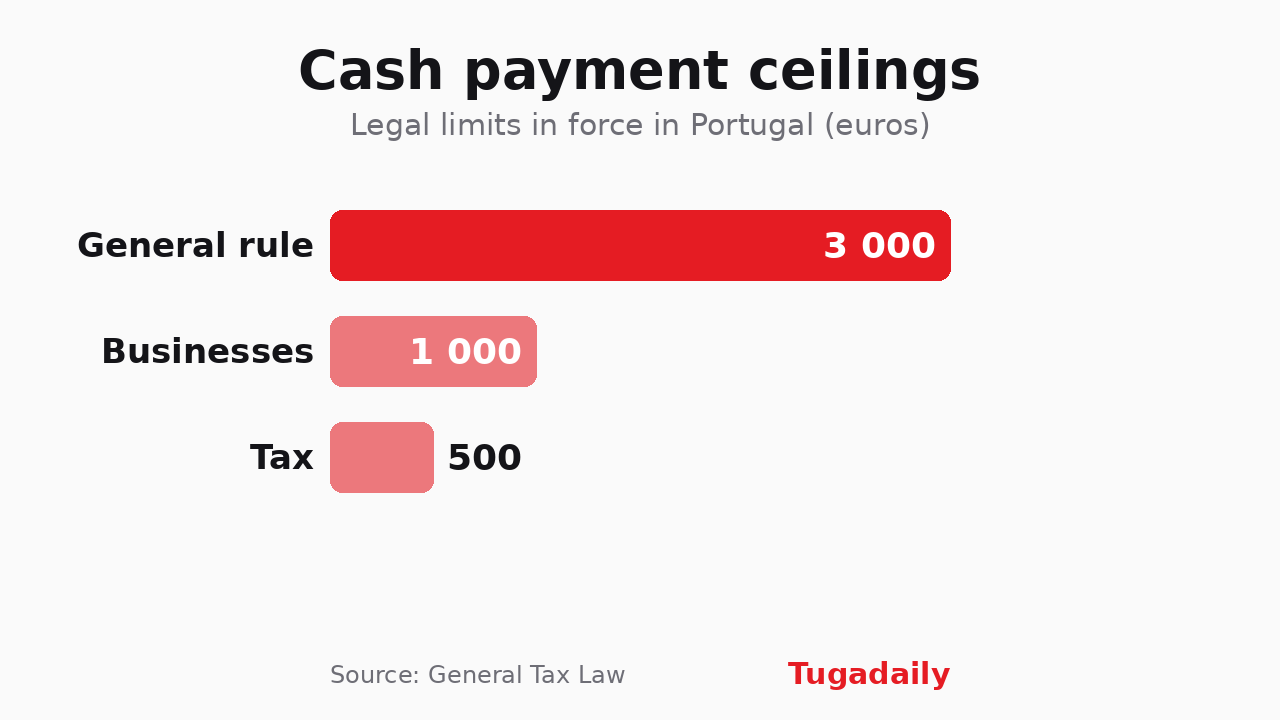
The rule sits in Article 63-E of the General Tax Law and has been in force for years. It prohibits paying or receiving cash in amounts equal to or above €3,000. Note the wording: equal to or above. A transaction of exactly three thousand euros cannot be settled entirely in notes either.
The ban applies to both sides of the counter
It is not only the buyer who is exposed. Whoever receives the money falls under the same prohibition, which is why so many dealerships and contractors refuse large cash payments outright even when the customer is keen.
Slicing the payment up does not help. Amounts linked to the same sale or the same service are added together, so breaking a €4,500 purchase into three payments of €1,500 does not make it lawful.
Two lower thresholds almost nobody knows about
For companies and self-employed people subject to corporate income tax, and for those under personal income tax who must keep organised accounts, the line drops sharply. Where an invoice or equivalent document is worth €1,000 or more, payment must use a method that identifies the recipient: bank transfer, named cheque or direct debit.
A third threshold is lower still, on the state’s side. Tax payments above €500 cannot be settled in cash at all.
What Europe imposes in 2027
The European Union has approved a common ceiling of €10,000 through Regulation (EU) 2024/1624, but that provision only starts to apply on 10 July 2027. Because the European figure works as a harmonisation floor rather than a cap, Portugal keeps its €3,000. Anyone budgeting for a large purchase should keep watching the Portuguese number, not the European one.
None of this touches everyday spending. Coffee, the market and lunch carry on exactly as before. The rule exists for high-value transactions, where the payment trail matters — and where getting it wrong costs far more than the monthly savings delivered by the €20 rail pass extension to urban lines.
By Beatriz Mota
Chart: Tugadaily