
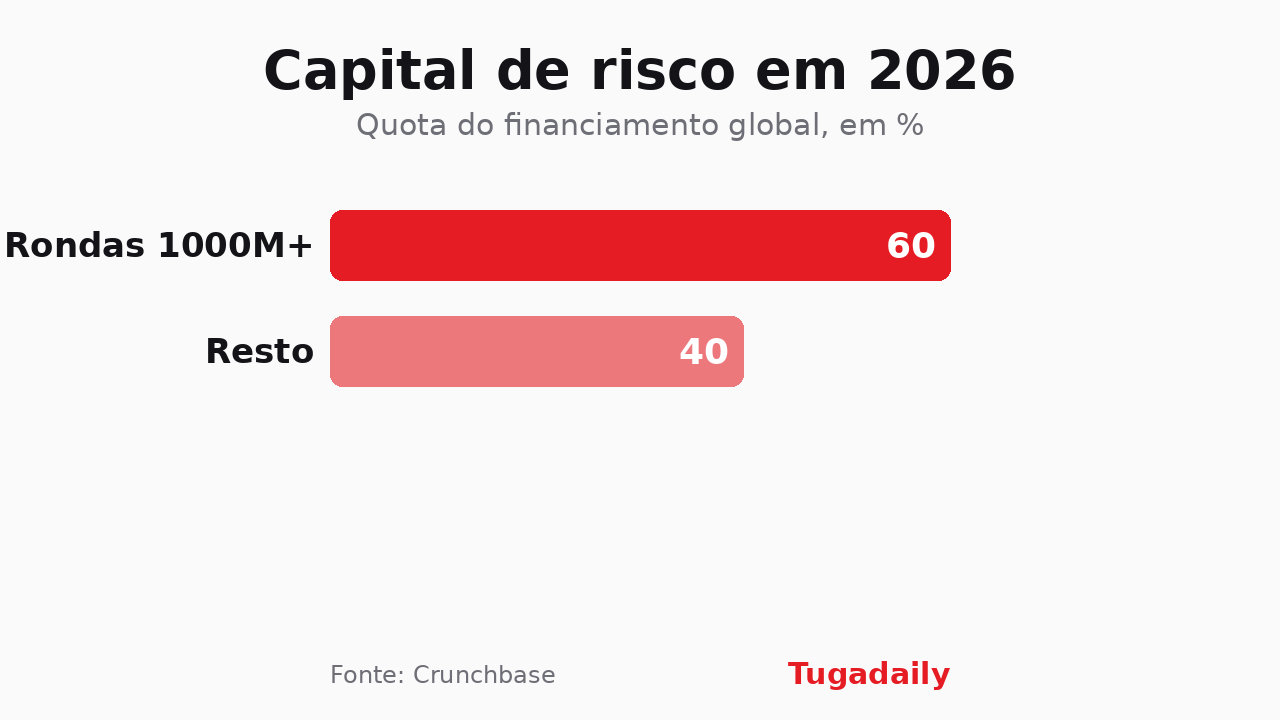
Six in every ten venture dollars went into giant rounds this year
Around 60% of global startup funding in 2026 went to rounds of $1 billion or more, roughly $320 billion in total. It explains a lot about the mood among founders.
Roughly 60% of all startup funding worldwide this year went into rounds of $1 billion or more. Those giant deals soaked up close to $320 billion. That single statistic explains a contradiction currently annoying half the industry.
How can the market be at record highs and terrible at the same time?
Because the totals lie. Venture investment can look historically strong on a chart while plenty of seed and Series A founders describe a brutal fundraising environment. Both things are true simultaneously.
It takes only a handful of mega-rounds involving well-capitalised AI labs, data centre businesses and established private companies to push the aggregate up, without improving access to capital for anyone else. The pie grows and keeps getting cut into the same two or three slices.
Why did the money concentrate like this?
Because investors are backing whoever can lock down scarce resources: computing capacity, frontier models, infrastructure. And because these companies genuinely need far more capital than a traditional software startup — they have to buy chips, build data centres, sign decade-long electricity contracts or finance advanced manufacturing.
What is the risk?
It cuts both ways. Enormous rounds fund ambitious projects that ordinary financing could never carry, which is good. They also inflate valuations, lock talent and compute inside a handful of firms, and leave early-stage companies fighting over a shrinking share.
For anyone raising, the message is blunt: headline figures no longer describe the market most companies actually live in. It is the same force showing up in the accounts of the giants, with Alphabet slipping into negative free cash flow rather than fall behind. The aggregate data is published by Crunchbase News.
By Beatriz Mota
Infographic: Tugadaily · data Crunchbase